

Infosec Briefing: Social Engineering Arrest, Teams Phishing Chain, and Frontier AI Defense Signals#
This episode covers Tylerb’s guilty plea, Rest of World reporting on Seguritech border surveillance, Hormuz crypto SMS scams, the Apple notification-store CVE, the UNC6692 Teams chain, CERT-In’s AI advisory, and discussion of Glasswing/Mythos, OpenAI cyber models, Project Deal, and token spend. Evidence grading is noted in each section.
Social-engineering crew and OPSEC: Tylerb pleads guilty#
What happened. U.K. Scattered Spider member Tyler Robert Buchanan (handle Tylerb) pleaded guilty to wire fraud conspiracy and aggravated identity theft; arrested in Spain in June 2024 and extradited to U.S. custody from April 2025 onward. KrebsOnSecurity reports investigators tied years of activity by reusing the same username/email on phishing domain registrations, with Namecheap records showing the registering account had logged in from his home IP less than a month before the phish.
Technical takeaway. Identity and infrastructure reuse can chain multi-year activity into a prosecutable trail; the plea names victims including Twilio and LastPass—MGM/M&S reflect the crew’s historical reputation and are not named in this plea document.
What engineers should do. Correlate phishing domains, registration emails, and passive DNS; strengthen helpdesk/collaboration social-engineering drills.
Border surveillance capability and cross-border data#
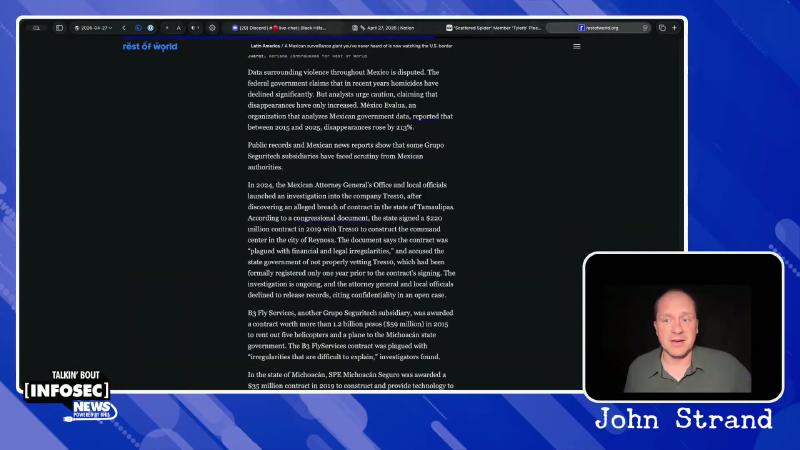
What happened. A Rest of World investigation describes Mexico’s Grupo Seguritech and twenty-plus subsidiaries building integrated surveillance packages—C5 command centers, cameras, drones, license-plate recognition—for Mexican government clients; public records cite at least 63 government contracts since 2012 totaling roughly 21.8 billion pesos (~$1.27 billion USD, not inflation-adjusted). On the border, Plataforma Centinela (Ciudad Juárez) and a 2022 Texas–Chihuahua MOU sharing Chihuahua-side data are among the arrangements described.
Technical takeaway. Risk sits in exported surveillance capability and cross-border data governance, not a single CVE. Do not summarize as “U.S. federal prime contract”—FOIA requests to CBP for federal contract records returned no matching disclosures.
What engineers should do. Specify data residency, subprocessors, and audit rights in procurement; independently assess third-party monitoring platforms.
- Rest of World: Seguritech company profile (2026-04-08)
- Rest of World: $1.27B surveillance empire (2026-04-16)
Geopolitics-layered SMS phishing#
What happened. Per the Reuters headline chain (full text not directly retrieved this pass; details via secondary coverage), Greek maritime risk firm MARISKS warned scammers text shipping operators posing as Iranian authorities, demanding bitcoin or tether “transit fees” for “safe passage” through Hormuz.
Technical takeaway. Classic news-jacking phishing: real strait transit and fee headlines lower victim skepticism. Coverage labels it a scam; scale and attribution unverified.
What engineers should do. Run timely-phishing drills for finance and ops; require out-of-band confirmation for payment changes.
Notification-store retention and mobile forensics#
What happened. Apple fixed CVE-2026-28950 in iOS 26.4.2 / iPadOS 26.4.2 and related releases: Notifications marked for deletion could be unexpectedly retained on the device (logging issue; improved data redaction). Secondary reporting says law enforcement recovered deleted Signal message previews from notification residue; Apple/CVE text does not name Signal.
Technical takeaway. E2EE does not remove notification/UI-layer leakage; post-uninstall retention widens forensic surface.
What engineers should do. Disable lock-screen message previews; push 26.4.2+; include notification stores in DFIR checks.
Fake IT desk on collaboration software: UNC6692#
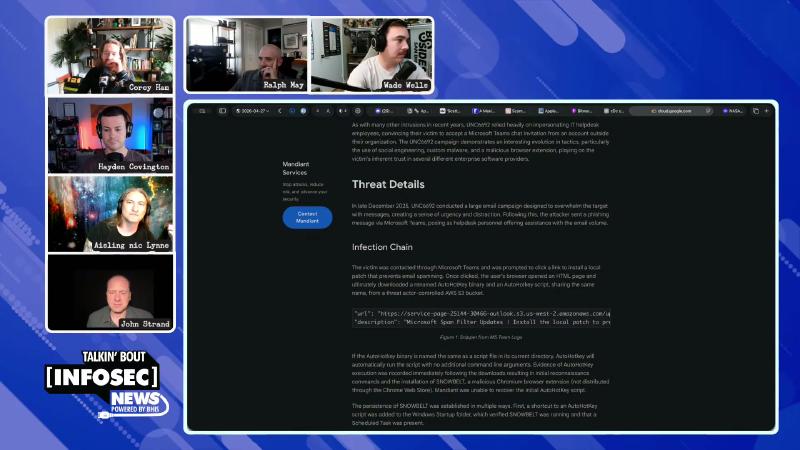
What happened. Mandiant disclosed UNC6692 (Snow Flurries): email flooding for urgency → external Microsoft Teams account impersonating helpdesk → lure to install an “anti-spam patch” → download identically named AutoHotkey binary and script from attacker AWS S3 → deploy malicious Chromium extension SNOWBELT (not Chrome Web Store). Large-scale email activity in late December 2025.
Technical takeaway. Components are not novel, but deep social engineering + collaboration-tool trust shortens contact-to-execution time. Mandiant does not describe AI assistance; the show’s “threat actors broadly use AI” vs. “report omits AI” is a speaker opinion.
What engineers should do. Restrict external Teams chat; control S3 hotlinks and AutoHotkey; monitor Startup/scheduled-task anomalies.
National CERT response to frontier AI risk#
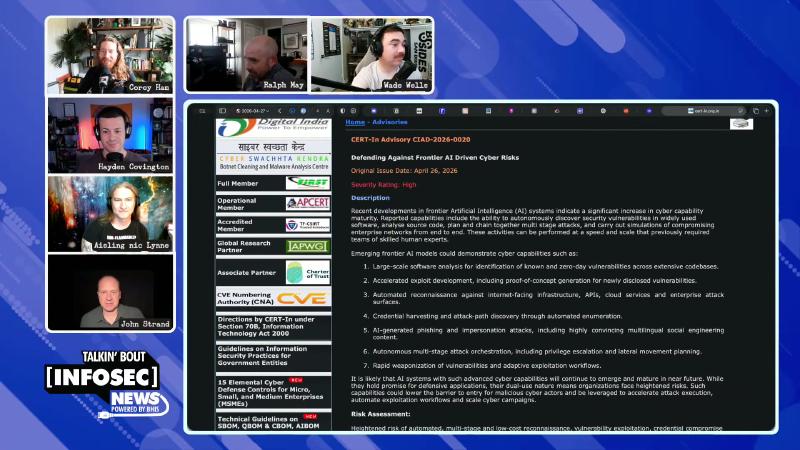
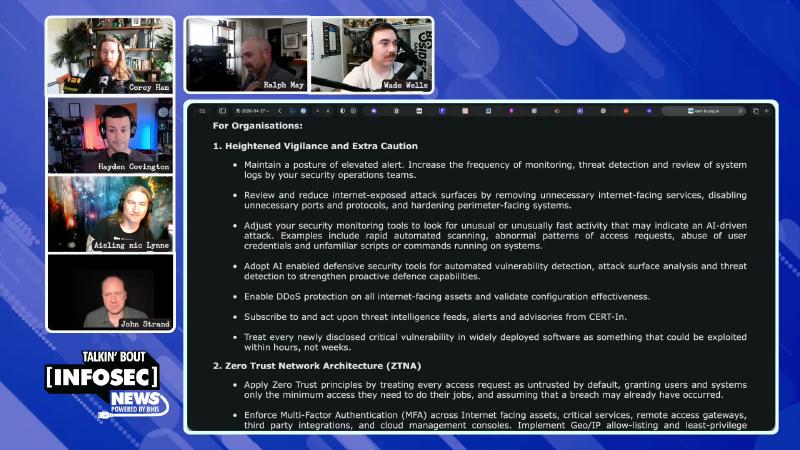
What happened. India’s CERT-In issued CIAD-2026-0020 Defending Against Frontier AI Driven Cyber Risks (2026-04-26, severity High). OCR and the show align on seven capability concerns (large-scale code/vuln analysis, accelerated exploit/PoC work, automated recon, credential harvesting, AI-generated phishing, multi-stage orchestration, etc.) and organizational guidance: heightened vigilance, ZTNA, 24-hour critical patching for internet-facing systems, OpenSSF Scorecard, and SBOM/QBOM/CBOM/AIBOM. cert-in.org.in could not be re-fetched this pass; fields per OCR.
Technical takeaway. Official guidance compresses critical vuln response to “hours,” resonating same-week with UNC6692 and restricted cyber-model access debates.
What engineers should do. Align change windows to 24h patching; MFA on external access; subscribe to CERT-In and vendor advisories.
Access disputes over restricted cybersecurity models#
What happened. Press reports a Discord group claiming restricted Anthropic capability access; a spokesperson said they are investigating reports of unauthorized access to Claude Mythos Preview via a third-party vendor environment and have not found evidence of the claimed impact (quotes per TechCrunch full text). Official Project Glasswing pages call the pilot Claude Mythos 2 Preview, with 40+ organizations on extended access via Claude API, Bedrock, Vertex AI, Microsoft Foundry, etc.
Technical takeaway. Narrow pilots still face supply-chain and API-key constraints; short queries ≠ weight exfiltration (“hype breach” is a speaker opinion).
What engineers should do. Key rotation, least privilege, anomalous-call monitoring; forensics before external disclosure.
Commercial models’ “cyber-specialized” track#
What happened. Amid Mythos coverage, OpenAI advances restricted access for cyber defenders (official blog returned 403 this pass); TechCrunch says GPT-5.5 Cyber will open only to critical cyber defenders. Show mentions of GPT-5.4 Cyber, Cyber Gym ~84 points, Mythos “~270 vulns / 180 exploits” are speaker recaps, not verified against accessible primaries. Anthropic’s Mozilla partnership post cites Claude finding 500+ zero-day vulnerabilities in open-source software (different counting basis than show figures).
Technical takeaway. Model access is now a security-policy issue; longer autonomous runtimes amplify automated attack-chain concerns.
What engineers should do. Include high-capability models in vendor risk reviews; detection should focus on automated orchestration behavior, not vendor narrative.
- OpenAI: Scaling trusted access for cyber defense
- TechCrunch: OpenAI restricts Cyber access too (2026-04-30)
- Anthropic: Mozilla Firefox security partnership
AI agent trading experiment#
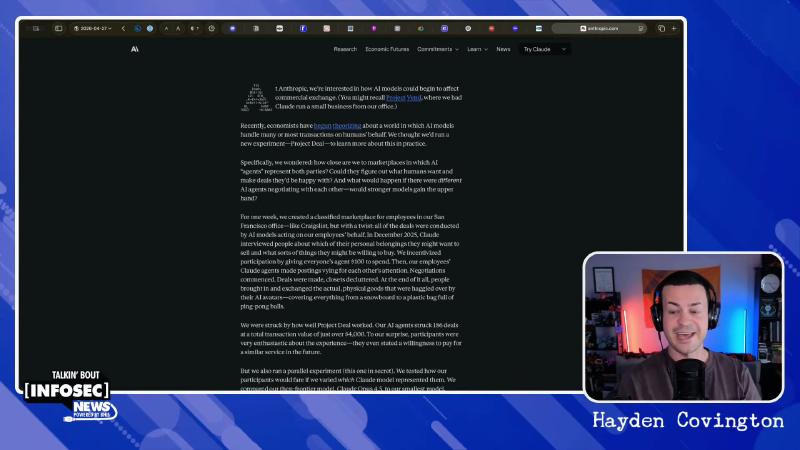
What happened. Anthropic ran Project Deal at its San Francisco office for one week in December 2025: employee Claude agents bought/sold personal items and negotiated prices on a $100 budget each; official write-up records 186 deals, just over $4,000 total volume, and parallel tests of whether stronger models bargain better.
Technical takeaway. Stronger agents winning negotiations without user awareness maps to agent commerce and authorization abuse (speaker extension).
What engineers should do. Disclose model tier and human review; monitor agent payments and OAuth.
High token bills and unit economics#
What happened. The show discusses startup teams boasting on social media about ~$113k last-month AI bills (four-person company) and token maxing culture—high burn as a signal of intensity. Specific tweet primaries not located this pass; figures not independently verified; whether OpenAI is profitable or Amazon building AI infra are speaker opinions, not earnings citations.
Technical takeaway. If accurate, this is unit economics, not security maturity ($113k bill unverified).
What engineers should do. API budget alerts and model routing; separate security spend from product burn rate.
Compiled from public sources and show discussion; topics without a technical anchor (e.g., Cult of the Dead Cow revival) omitted.