

Infosec Briefing: CA Support Desk Breach, Kernel Privilege Escalation, and ATT&CK Tactical Restructuring#
This episode covers the DigiCert support-portal intrusion and EV code-signing revocations, in-the-wild MOVEit exploitation signals, a cPanel authentication bypass, the Linux “Copy Fail” local privilege escalation, an AI-agent database-deletion cautionary tale, Musk’s distillation testimony, Utah age-verification and VPN legislation, clinical AI scribing controversy, MITRE ATT&CK v19 restructuring, and Mitchell Hashimoto’s departure from GitHub. Each section notes evidence boundaries.
Trust chain broken by social engineering: DigiCert support portal#
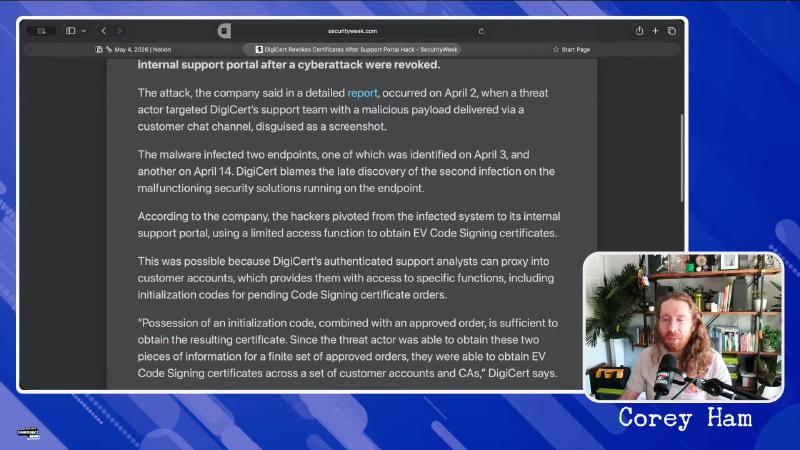
What happened. SecurityWeek summarizes DigiCert’s incident report: on April 2, attackers delivered a malicious payload disguised as a screenshot through the customer chat channel, infected a support engineer’s workstation, entered the internal support portal, and used analyst customer-on-behalf operations to obtain initialization codes and issue roughly 60 EV Code Signing certificates for already-approved orders (27 explicitly tied to threat actors); community reporting says 11 were used to sign Zhong Stealer. A second workstation was not discovered until April 14; the vendor attributes the delay to malfunctioning security solutions on the endpoint. Related certificates were revoked by April 17. Show discussion mentions .scr delivery inside a ZIP; the SecurityWeek article does not state the file extension (pending verification against DigiCert’s original text; the vendor news page could not be fetched for this pass).
Technical takeaway. EV code signing mainly improves static reputation and landing-stage trust; it does not bypass EDR behavioral detection—monitor processes and network traffic after the “entry credential.”
What engineers should do. Audit your organization’s EV/code-signing certificate chain; sandbox attachments on support channels; still run behavioral detection on signed samples.
- SecurityWeek: DigiCert revokes certificates after support portal hack (vendor report recap)
- DigiCert incident statement (HTTP 200; body not verified this pass)
Hot file-transfer and hosting panels: patch priority#
What happened. The show reports MOVEit is seeing in-the-wild exploitation again; the vendor has released patches and there is no public PoC yet; browser-tab OCR reads “Progress warns of critical MO…”. Specific CVE numbers and Progress advisory text for this round could not be verified from NVD/CISA/vendor sites this pass (unable to verify). On the cPanel/WHM side, CVE-2026-41940 is an authentication bypass in the login flow (CWE-306), CVSS 9.8, unauthenticated remote access to the control panel; CISA KEV added it 2026-04-30.
Technical takeaway. Popular SaaS and hosting panels often become “shadow IT”—a marketing site bought years ago still exposes cPanel, stacked with corporate LDAP/password reuse. Until MOVEit details are filled in from the vendor’s primary sources, any deployment should track Progress security channels.
What engineers should do. If you run MOVEit: check Progress security advisories and patch immediately. Inventory cPanel/WHM assets (including GoDaddy-style managed hosting); upgrade to versions listed in the vendor 2026-04-28 security update.
- NVD: CVE-2026-41940
- CISA KEV: CVE-2026-41940
- cPanel security update (2026-04-28)
- Progress security portal (track MOVEit advisories from here)
Kernel logic flaw: Copy Fail (CVE-2026-31431)#
What happened. The community calls it Copy Fail; CVE-2026-31431 stems from a logic flaw introduced by an in-place optimization in the Linux kernel’s crypto: algif_aead, reachable via AF_ALG / splice to achieve controlled writes to the page cache and local privilege escalation (oss-security, copy.fail). copy.fail says the PoC is about 732 bytes, no race; CISA KEV added it 2026-05-01. NVD CVSS 7.8 (AV:L).
Technical takeaway. Fix requires a kernel package update and reboot; installing unattended-upgrades without rebooting lengthens the exposure window (ops inference, not a statistical claim).
What engineers should do. Patch per your distro’s stable security advisories; reboot in maintenance windows; include cloud single-tenant hosts in privilege-escalation surface reviews.
AI agent permissions: PocketOS database wipe and Musk distillation testimony#
What happened. (database wipe) The New Stack reports (2026-04-25, third-party account): a Cursor coding agent at car-rental SaaS PocketOS deleted the production database in under ten seconds, with volume-level backups in the same blast radius as production; root causes include an overly broad Railway CLI token and the agent not obtaining human confirmation first. The show is skeptical of “founder blames AI” narratives (manual rm, marketing, etc.—speaker opinion); even if true, the risk sits in god-mode OAuth/MCP and non-isolated backups.
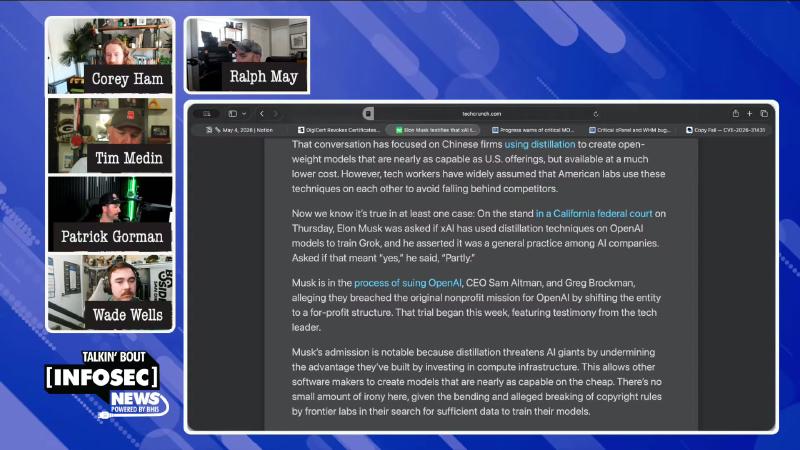
What happened. (distillation) TechCrunch reports: in Musk’s suit alleging breach of OpenAI’s nonprofit mission, asked whether distillation on OpenAI models was used to train Grok, he first said it was industry-common, then under follow-up answered “Partly.” (quoted as in the report).
What engineers should do. For AI agents: read-only/split-environment credentials, plan-mode review, isolate backups from production. For model supply chain: treat API-output distillation as threat-model input on par with weight theft (vendor public opposition to third-party distillation coexists with litigation testimony—motivation read as speaker opinion).
- The New Stack: Cursor agent deletes PocketOS production database
- TechCrunch: Musk testifies xAI trained Grok on OpenAI models
Age-verification legislation and VPNs: Utah SB 73#
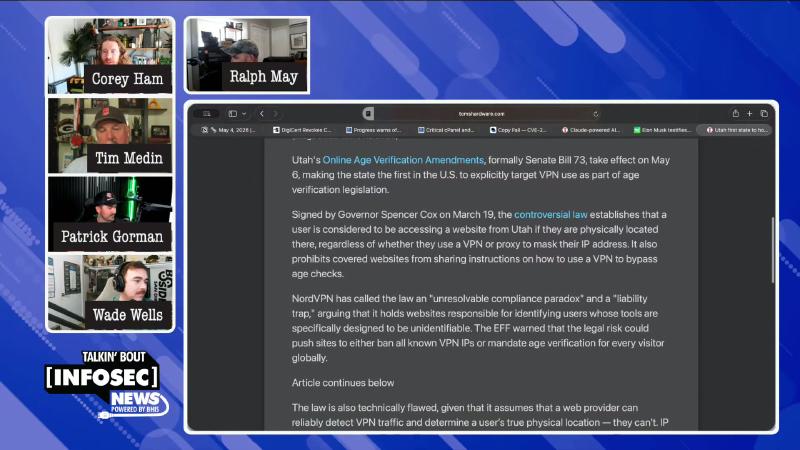
What happened. Per show screen captures of Tom’s Hardware and other secondary coverage (official bill text could not be fetched and verified this pass): the Utah Online Age Verification Amendments (Senate Bill 73) take effect May 6; users at a physical location in Utah are treated as in-state access and may not provide covered websites with how-to tutorials on using VPNs to bypass age checks. NordVPN calls it an unresolvable compliance paradox and a liability trap; the EFF warns of blocking known VPN IPs or forcing age verification on global visitors. Sites cannot reliably distinguish VPN use from true geolocation (reporting argument).
Technical takeaway. Compliance pressure may spill into IP/ASN blocking or global age gates, conflicting with privacy-tool ecosystems; prosecutors proving a user “illegally used a VPN” would still face a very hard evidentiary path (speaker opinion).
What engineers should do. Products operating in the U.S. that reach Utah users: run legal and geo-compliance review; do not assume IP databases alone can separate VPN traffic.
Clinical AI scribing and ATT&CK v19#
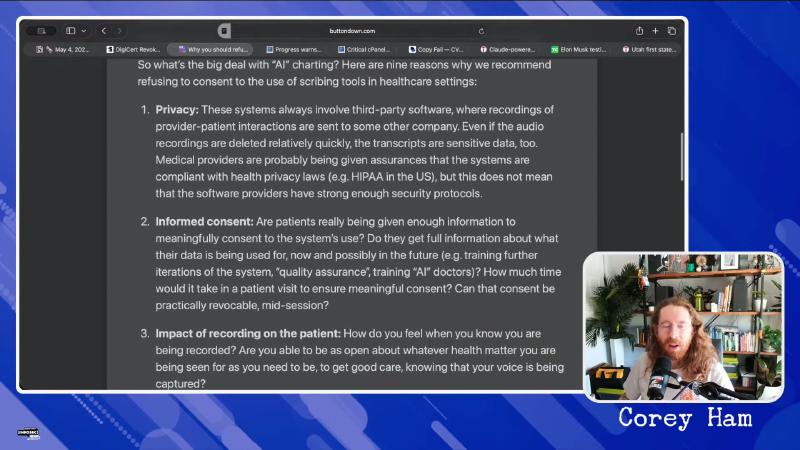
What happened. (medical records) Emily M. Bender and Decca Muldowney published on buttondown.com (show screen capture; exact URL pending verification), title along the lines of Why you should refuse to let your doctor use AI scribing, listing nine reasons patients should refuse consent to third-party recording-to-chart workflows (privacy, consent, automation bias, disparate impact, etc.). Show debate: privacy/HIPAA is a separate compliance topic; clinicians also rely on transcription for retrieval (multiple viewpoints, not a single conclusion).
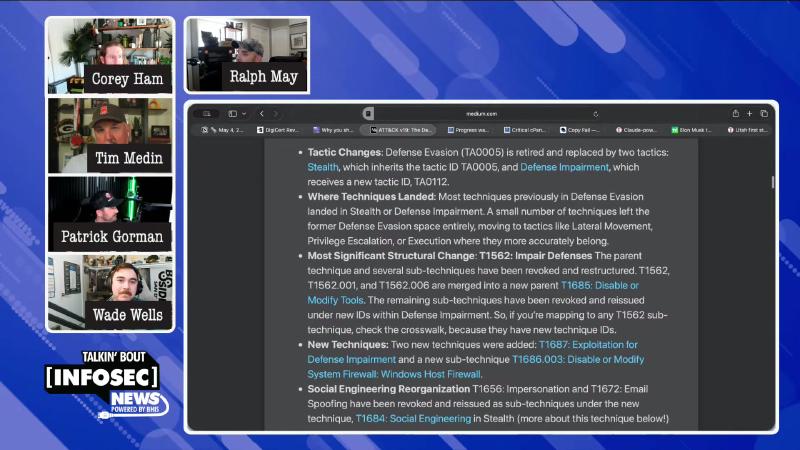
What happened. (ATT&CK) ATT&CK v19 (April 2026) splits former Defense Evasion into Stealth — TA0005 (retains the ID; hide and conceal) and Defense Impairment — TA0112 (weakening defenses); T1562 is retired, succeeded by T1685 Disable or Modify Tools; new techniques include T1687 Exploitation for Defense Impairment.
What engineers should do. Healthcare: document informed consent and data use; do not default to opt-in. Blue teams: remap detection rules and labels per MITRE transition materials (show joke about using Claude to fill forms—not an ops recommendation).
Dev hosting availability: Ghostty leaving GitHub#
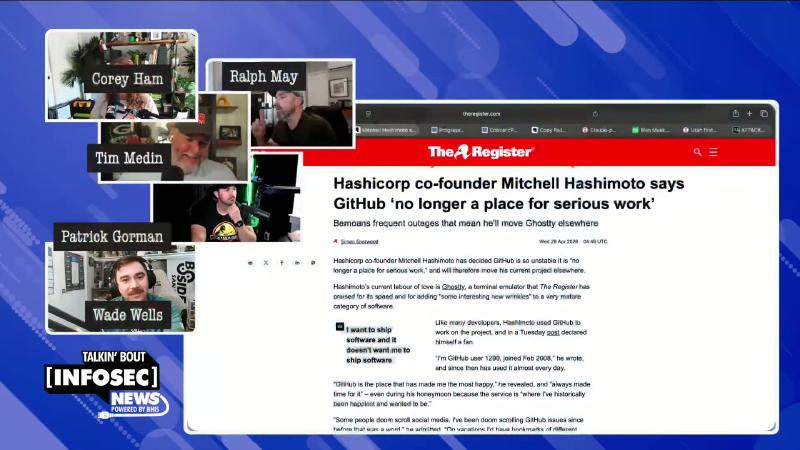
What happened. HashiCorp co-founder Mitchell Hashimoto (2026-04-28) wrote that near-daily GitHub outages (including GitHub Actions) have disrupted his work for months, calling GitHub “no longer a place for serious work” and moving primary development of terminal Ghostty elsewhere; a read-only GitHub mirror and personal projects remain. The post explicitly distinguishes the April 27 Elasticsearch major outage from the interruptions he complains about (not the same incident). The Register’s contemporaneous reporting was not re-fetched this pass.
Technical takeaway. The dispute is availability/CI interruption, not privacy; Git’s distributed model still leaves local clones as a recovery path (show discussion).
What engineers should do. For critical private repos, evaluate a second host or self-hosting (e.g. GitLab); plan fallbacks and mirrors for Actions dependencies.
Compiled from public sources and show discussion; sidebar topics without technical anchors (e.g. Claude reporting, Trellix source-repo chatter) omitted.