

Infosec Briefing: Education SaaS Second Strike, Cluster RCE, and Silent Browser AI#
This episode focuses on several early-May 2026 storylines with direct blue-team operational relevance: ShinyHunters’ return against Canvas parent Instructure, Wazuh cluster sync path traversal, Chrome on-device AI disk and privacy controversy, and unauthorized access to Trellix source repositories. Each section follows an incident–meaning–recommendation structure; figures not backed by vendors or regulators are labeled with source boundaries.
Education SaaS: maintenance window, Free-For-Teacher, and per-school ransom pressure#
What happened. Ransom group ShinyHunters again targeted Instructure (operator of the Canvas LMS). KrebsOnSecurity reports attackers placed notices on many tenant login pages (visible text includes “ShinyHunters has breached Instructure (again)”), urging individual schools to negotiate ransom on their own even if headquarters does not pay; extortion claims cite roughly 275 million users and nearly 9,000 institutions—all unilateral group claims with no independent forensic publication.
Instructure’s official FAQ gives a more specific technical narrative: unauthorized Canvas activity detected 2026-04-29; on 05-07 the threat actor regained access via a “second Canvas vulnerability,” disabled within about 10 minutes; both rounds used Free-For-Teacher accounts, with exploitation of a support tickets vulnerability confirmed and shutdown of that free tier planned. The platform entered maintenance mode broadly; some users saw “Canvas is currently undergoing scheduled maintenance.” Third party Dipan Mann (Cloudskope) criticized framing the outage as scheduled maintenance; see his analysis for the September 2025 Penn leak and May 2026 timeline—third-party analysis, not Instructure’s position. Reporting once cited anonymous investigative sources that multiple universities had contacted the group; Instructure later said it reached an agreement with attackers and received data-destruction confirmation (shred logs), with customers not required to contact attackers separately—the two public narratives have a time gap; do not conflate them.
Technical takeaway. If vendor attribution holds, the attack surface centers on low-privilege free accounts and support-ticket channels rather than the classic “large customer breached directly” story; cross-tenant lateral movement from FFT into paid tenants remains guest speculation—not acknowledged officially. Recurrence after “contained” is engineering-plausible in SaaS, but on-show “residual API token caused second outbreak” is speaker hypotheticals with no source. Group claims of “billions” of private messages: not independently verified; the May 6 vendor statement cites names, email, student IDs, and user messages, denying passwords, DOB, government IDs, and financial data. The incident landed in North America’s final exam week (per Krebs), amplifying operational harm; whether timing was deliberate unproven.
What engineers should do. Align notifications and log retention with the official FAQ and status incident page; assess potential minor data with legal (COPPA cited only as a compliance framework—no regulatory finding in this case). Threat-model “worst business day” (finals, tax season) into exercises, not only retail holidays. Monitor SaaS-side mass download / API anomalies (Salesforce history is a separate case, not a CVE for this incident).
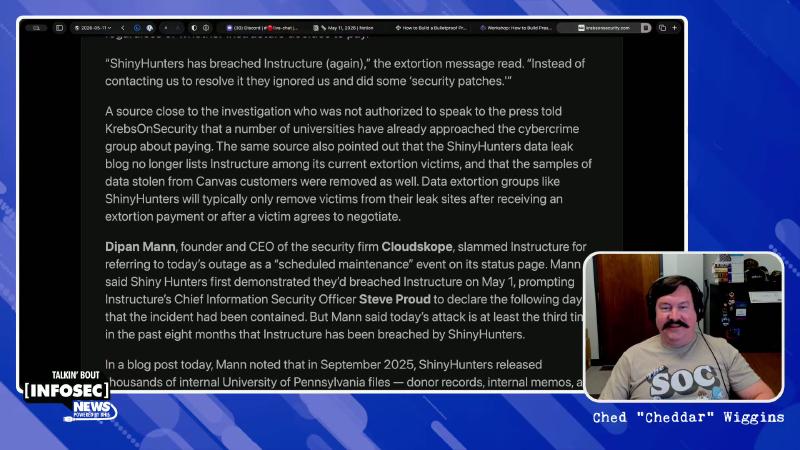
KrebsOnSecurity: visible “ShinyHunters has breached Instructure (again)” and extortion quotes.
Wazuh: path traversal from authenticated cluster nodes → RCE#
What happened. GitHub Security Advisory GHSA-m8rw-v4f6-8787 (CVE-2026-30893, CVSS 9.0) discloses that decompress_files() during cluster sync decompression does not validate paths; lines 454–465 of framework/wazuh/core/cluster/cluster.py pass attacker-controlled filepath directly to os.path.join(), allowing an authenticated cluster peer to write files at arbitrary paths on other nodes and achieve RCE by overwriting Python modules. Affected wazuh-manager >= 4.4.0; patch >= 4.14.4 (per GitHub Advisory; on-show OCR once misread CVE/GHSA and patch numbers).
What engineers should do. Prioritize upgrade for clusters below 4.14.4; tighten cluster mutual authentication and network segmentation—advisory marks PR:H; do not ignore the cluster plane because there is no public internet path.
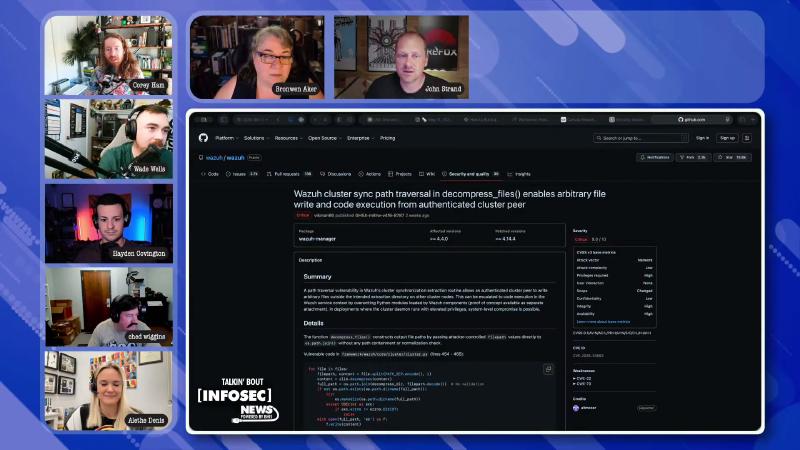
GitHub: “Wazuh cluster sync path traversal in decompress_files()… from authenticated cluster peer,” Critical 9.0.
Chrome: Built-in AI download obligation and “delete then re-download”#
What happened. Chrome developer documentation confirms Built-in AI requires downloading underlying models and recommends informing users about download time. Independent investigation That Privacy Guy reports that after users deleted roughly 4GB of Gemini Nano–related files, Chrome on Windows repeatedly re-downloaded them; durable disablement requires chrome://flags, enterprise policy, or uninstall. On macOS the author independently logged the download loop with fseventsd—behavioral claims come from third-party experiment, not equivalent official Google wording on “must re-download after delete.”
What engineers should do. Use Chrome Enterprise policy to govern AI features in the enterprise; individual users should not rely on manual file deletion alone—use policy or flags. Whether on-device AI is more private than full cloud: conditional; data may still reach Google.
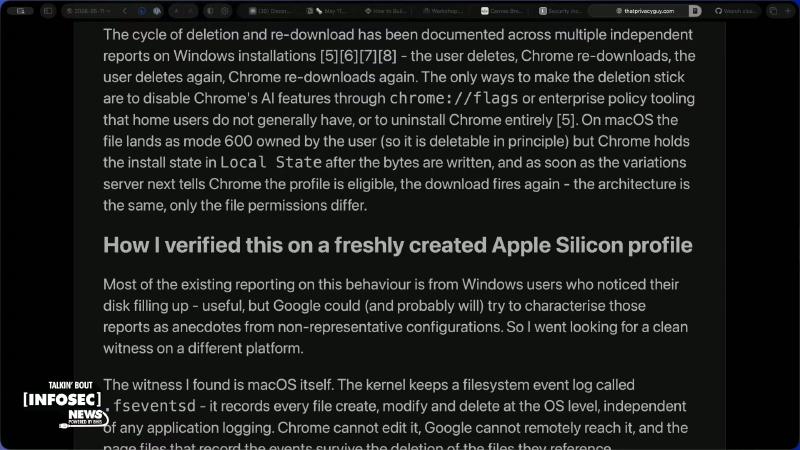
thatprivacyguy.com: “The cycle of deletion and re-download has been documented…” and macOS fseventsd verification paragraph.
Trellix: unauthorized access to source repositories#
What happened. Trellix told media that “certain source code repositories” saw unauthorized access; external forensics were engaged and law enforcement notified; as of the investigation, no impact on release processes or exploitation of source code was found (quotes via BleepingComputer reprint). RansomHouse claimed possession of source code—not yet reconciled with vendor statements; vendor statement page returned HTTP 403 on this pass—body taken from reprints. Show hypothesized social engineering as entry—vendor did not specify vector.
What engineers should do. Watch for vendor IOCs and patches; in source-leak scenarios, strengthen supply-chain monitoring and assume key/signature rotation.
Sidebar: outsourced help desk and social-engineering surface (generalized)#
ShinyHunters in cases such as ADT reportedly entered Salesforce via Okta voice phishing (Krebs citing other-case reporting)—not the confirmed Canvas intrusion chain. Outsourced front lines often hold high IdP privilege while optimizing for experience, similar to MSSP cost-cutting incentives; whether Canvas involved vishing is unconfirmed by show and vendor—Instructure attributes FFT/support tickets. This is industry-pattern discussion, not a single CVE for the week.
Draft verified against public primary sources; guest opinions, anonymous investigative sources, and group claims are distinguished in text. Rose Acre Farms / Lynx ransomware were mentioned only in passing on the show; no capturable primary source was found this round, so they are not expanded.