

From Records to Deconstructible Types: Amber’s Deconstruction–Reconstruction Path and Syntax Governance#
Abstract: When JEP 395 bundles immutable carriers, nominal tuples, and record patterns, any evolution beyond its constraints loses both compact syntax and expressive power on the pattern-matching side. Project Amber is elevating deconstruction by fixed component shape to a top-level type property and, in mail #2, narrows the narrative to deconstructible class; JEP 468 (Candidate, preview) has long awaited a broader class-level deconstruction path. This article explains motivation, terminology alignable with public documentation, and how engineers should read preview features and the upcoming Pattern Assignment (no Preview JEP yet; see Amber features 2026 mail) in dependency order.
Amber umbrella project and preview cadence#
Why#
Large language initiatives (generics, Valhalla, and similar efforts) have their own projects; day-to-day productivity improvements sit under Amber and ship as smaller JEP slices. Project Amber states that most features typically go through at least two rounds of preview before finalization (linked from JEP 12). Placing “carrier / deconstruction” in that context helps you judge it as incremental data-modeling enhancement rather than a rebuilt type system.
Mechanism and constraints#
- GA: text blocks, Records, sealed types, instanceof / switch pattern matching, Record Patterns, and related items already appear on Amber’s delivered list.
- Candidate / exploratory: JEP 468 (Derived Record Creation); deconstructible classes have no Preview JEP number yet (per public mail as of early 2026).
- Withdrawn: JEP 465 String Templates.
Mail #1 calls records + sealed types + record patterns the data-oriented “first arc”; carrier / deconstructible is the next chapter—that is design narrative (presenter’s view), not a JEP status field.
How to apply it#
In internal RFC templates, explicitly label ownership and preview rounds so reviews do not mix this work with value-type topics:
Feature: <name>
Ownership: Project Amber
Preview: yes/no; target JDK and --enable-preview (per the relevant JEP)
Common misconceptions#
Treating Amber as “one big feature”: it is an incubator for multiple independent JEPs with decoupled delivery schedules.

Wide-angle conversation: two people sit on opposite sides of a blue-and-green tiled table; a lit “DRAKE’S” sign is visible above the bar in the background; two amber drinks on the table; no slides or API text in frame.
Record semantics bundling and constraint boundaries#
Why#
JEP 395 describes record as nominal tuples and generates equals / hashCode / toString, canonical constructors, and related machinery. After pattern matching arrived, JEP 440 gave records record patterns automatically. The trade-off is that behavior is bound to record’s narrow constraints—the presenter calls this “bundling” multiple capabilities; the JEP text does not use that wording.
Mechanism and constraints#
- A
recordcannotextendsan arbitrary user class; its superclass is alwaysjava.lang.Record(JEP Description). - When you need inheritance, mutable fields, or to break the record model, you usually fall back to ordinary classes and hand-written boilerplate, and you lose natural alignment with record patterns. Beyond Records calls this gap falling off a cliff (design-note wording; the colloquial “two cliffs stacked” is presenter synthesis and does not appear verbatim in mail #2).
How to apply it#
// GA: compact within constraints + generated value semantics
public record OrderId(String tenant, long seq) {}

// When subclassing / mutable state is required, you often leave the record comfort zone
public abstract class LegacyOrderRef {
    public abstract String ref();
}
Impact on existing code#
GA record types need no changes. The discussion centers on when non-record types should gain equivalent deconstruction, not on rejecting records. The presenter is explicit: records are not a design mistake (presenter’s view); the goal is to unbundle capabilities for a wider class of types.
Common misconceptions#
Reading “cliff” as record failure: the record Non-Goals state that records are not a war to eliminate all boilerplate; the cliff describes a break in the evolution path, not that records should not exist.

Close-up, single camera: the speaker wears a purple polo and a lavalier mic; background plants and framed art are softly blurred; no identifiable slides—only the spoken-word setting.
From member deconstructors to type-level deconstruction#
Why#
Early exploration placed deconstructors inside the class body, symmetric to constructors (mail #1). Allowing overloaded deconstructors would inflate expressive power; in hindsight the example corpus almost always needs a single canonical deconstruction shape per class, not worth paying for extra freedom (statistical conclusion from presenter retrospective; mail emphasizes shifting to a class-level top-level property).
Mechanism and constraints#
- Rejected path: overloading explicit member deconstructors.
- Retained direction: a component list on the class header expressing “deconstructable along these components”; member-level patterns are still discussed separately in Towards Member Patterns, with examples marked non-final syntax.
Member-level deconstruction alone, as described orally, often yields only “deconstructible” plus accessor requirements—the compiler may not auto-generate equals / hashCode, and so on (true for the deconstructible model after mail #2).
How to apply it#
The sketch below expresses “type header aligned with accessors” intent only; it does not represent frozen keywords:
/** Intent: external deconstruction by (name, version) shape; equals etc. belong to another slice */
public final class ModuleRef {
    private final String name;
    private final int version;
    public ModuleRef(String name, int version) {
        this.name = name; this.version = version;
    }
    public String name() { return name; }
    public int version() { return version; }
}
Common misconceptions#
Assuming “a deconstructor member” equals record-level convenience: the first carrier version tried to bundle construction + full state description + Object method derivation in the class header; mail #2 self-corrected (see next section).

Medium close-up: the speaker faces sideways while gesturing; drinks and wall decor in the background; no code or specification slides.
Design iteration: carrier v1 and deconstructible v2#
Why#
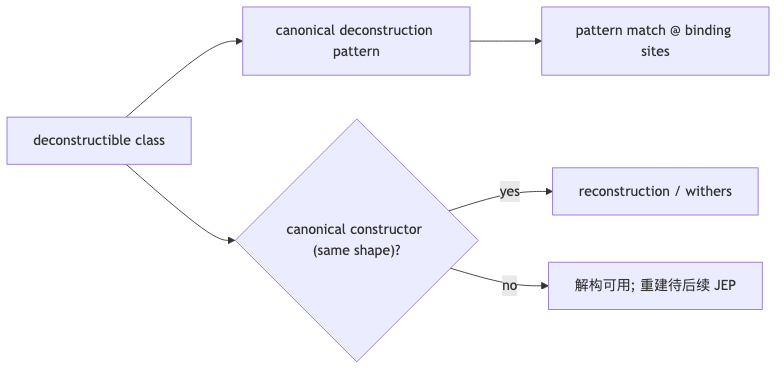
mail #1’s first carrier class let a class-header component list simultaneously promise: construct and deconstruct along that shape, with that shape as a complete, canonical, nominal description of state, enabling derivation of equals / hashCode / toString. mail #2 acknowledges this slid toward unprincipled concision—readers could not tell whether a missing equals was omitted or derived.
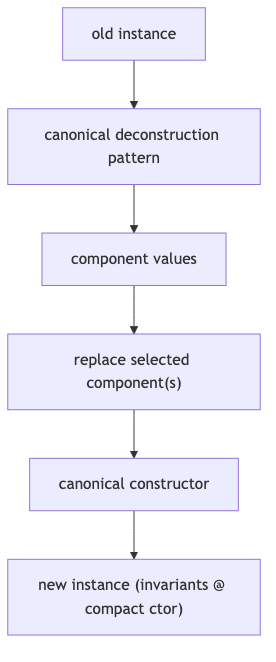
The second version narrows scope: a deconstructible class class-header list primarily denotes an API-level deconstruction shape (class components); if a constructor exists with the same names, types, and order as the components, the language treats it as a canonical constructor, unlocking Reconstruction (withers). equals / hashCode / field↔component mapping are filled in in later phases.
Document versions: Beyond Records design notes still align with mail #1; the latest design stance is mail #2. The oral “Lombok territory” analogy does not contain the literal word “Lombok” in mail #2 HTML.
Mechanism and constraints#
| Concept | Role in mail #2 |
|---|---|
canonical deconstruction pattern | Canonical deconstruction shape; supports pattern match |
canonical constructor | Constructor isomorphic to the component list |
reconstructible | When a canonical constructor exists, derived / wither-style reconstruction is available |
| record | A restricted subset of deconstructible |
How to apply it#
Semantic reconstruction (non-final syntax):
ModuleRef bump(ModuleRef original, int newVersion) {
    return new ModuleRef(original.name(), newVersion);
}
Impact on existing code#
When refactoring record → ordinary class, pain is not only in the type declaration but at every pattern match on that type. Shipping class/interface-level deconstruction first can ease pattern-matching breakage; boilerplate (equals, etc.) may still be handwritten for a while.
Common misconceptions#
Demanding a return to v1 “header derives full semantics” because field mapping is unresolved: mail #2 logic has chosen deconstruction-first; you cannot roll back to a strong-semantics carrier on that basis.

Brian Goetz close-up: purple polo, lavalier mic; water dispenser and plants blurred in the background; no slides—oral segment on the first carrier contract.

Two people at the blue-and-green tiled table; lit “DRAKE’S” sign in the background; drinks and sunglasses on the table; still no specification slides.
Phased delivery, interfaces, and JEP 468#
Why#
Amber can split what was once a single large release driver into multiple JEPs. Current narrative: deconstruction first (classes and interfaces), then equals/hashCode, derived accessors, and related pieces (mail #2 — What’s left?). Carrier interfaces appear in design notes v1 and mail #2 for interface state description / deconstruction scenarios (Carrier interfaces).
Mechanism and constraints — JEP 468#
JEP 468: Derived Record Creation (Preview) — Status: Candidate (not Delivered). Syntax: DerivedRecordCreationExpression → Expression with Block (official example: e with { ... }). Non-Goals state: not yet providing derived creation for ordinary non-record values.
Beyond Records — Reconstruction says JEP 468 is on hold—prose in design notes, not a JEP Status enum value. Rationale: wait until the class-level deconstruction path is clear, avoiding record special cases diverging from a broader class model.
Preview enablement (per the JEP page; does not mean shipped in a GA JDK):
javac --release 23 --enable-preview MyRecordDemo.java
java --enable-preview MyRecordDemo
Two reconstruction conceptual models (constructor sugar vs. a with block that “pretends mutability for a minute”) are still being weighed on amber-dev—presenter’s view; final syntax was not verified against fetched OpenJDK pages.
How to apply it — preview slices#
Whether JEP 468 ships in the same preview bundle as deconstructible classes—the oral line is “We might and we might not” (open question). “Slice the salami as thin as … we’d like” implies production code may go through multiple preview rounds of API adjustment (JEP 12).
Common misconceptions#
Seeing JDK 23 examples on the JEP 468 page and assuming production readiness: check the specific JDK release notes and --enable-preview flags; Candidate features can change at any time.

Brewpub wide shot: bar stools, bar, and “DRAKE’S” sign; speaker gesturing—oral segment on phased delivery and the “double cliff.”

Listener in black leans forward on the left; purple polo speaker on the right; “DRAKE’S” clear in the background; no JEP 468 slide text.
Marshalling and serialization: what public text supports#
Why#
If assembly/disassembly protocols are clear at the language level, intermediate states can be JSON, bytes, or other wire forms—not necessarily Java heap objects. Beyond Records Looking ahead lists directional sentences on automatic marshalling / unmarshalling for record instances.
Mechanism and constraints#
- Language prerequisites: deconstruction shape, canonical construction, and (on records) JEP 468’s
with. - Towards Better Serialization opens by stating it is an exploratory document and does not constitute a plan.
- Podcast phrases “plain marshalling” and “Serialization 2.0” were not found verbatim in searched OpenJDK HTML; external write-ups should link design notes and must not treat oral aliases as normative terms.
How to apply it#
Minimal HTTP skeleton (demo uses custom header X-Demo-Tenant; HttpServer and HttpClient live in different modules):
int port = 8080;
var server = HttpServer.create(new InetSocketAddress(port), 0);
server.createContext("/widgets", ex -> {
    String tenant = ex.getRequestHeaders().getFirst("X-Demo-Tenant");
    byte[] body = ex.getRequestBody().readAllBytes();
    // Widget w = mapper.readValue(body, Widget.class);
    ex.sendResponseHeaders(201, -1);
    ex.close();
});
Common misconceptions#
Treating exploratory notes as an imminent GA Serialization replacement: Towards Better Serialization explicitly denies that it “constitutes a plan.”

Mid-shot conversation: speaker’s hands open in explanation, listener watching; bar furnishings in the background—oral segment on field↔component mapping as “confident but non-blocking.”
Governing syntax discussion: semantics first, surface form later#
Why#
mail #1 opening asks to discuss concepts and directions rather than syntax. Syntax should be evocative, but premature, opinion-only syntax battles can crowd out semantic feedback bandwidth—“Syntax discussions… worthless / worse than worthless” is the presenter’s view; it does not appear on OpenJDK pages.
Mechanism and constraints#
- Normative reading order: design notes / mail → JEP draft → syntax draft.
- Feedback channels: each JEP Discussion line,
amber-dev; preview features require JDK build and--enable-previewreproduction (JEP 12: feedback based on real world use). - For previewed features: willingness to rewrite APIs across preview rounds; for not yet runnable memos, good scenario questions still help (presenter’s view).
How to apply it#
Review checklist:
1) State semantic invariants in one sentence—do not lead with “Kotlin is better” preferences;
2) Preview features: list JDK build, --enable-preview, minimal reproduction;
3) Mark syntax opinions as secondary, after semantic consensus.
Common misconceptions#
Arguing keywords from the JEP title alone: JEP 12 states preview features are “fully specified, fully implemented, and yet impermanent”—the community is still co-understanding semantics at ship time.

Left speaker with arms spread in explanation, right listener attentive; “DRAKE’S” sign in the background; OCR residue “Ree DRAKE SY” consistent with the lit sign area.

Wide conversation: OCR on the lit sign area reads “Frana. RORAKE SY,” matching the bar sign location; drinks and sunglasses still on the table.

Mid-shot conversation: OCR line “Ree DRAKE SY” visually consistent with the background sign; no language-specification slides.
Pattern Assignment: unconditional patterns and imperative deconstruction assignment#
Why#
When the compiler and reader can statically determine that a pattern unconditionally matches, wrapping it in if (!(... instanceof ...)) only adds noisy branches and misleading else paths. Amber features 2026 is titled PATTERN ASSIGNMENT; the oral phrase “enhanced local variable declarations” should be read as informal naming for the same direction.
Mechanism and constraints#
- No Preview JEP yet; mail says a draft JEP will follow separately.
- Verified example (mail):
ColorPoint(var x, var y, var c) = cp; - Semantic anchor: JLS 14.30.3 unconditional patterns.
- “Explored about 14 syntax variants, preview incoming”—presenter’s view; mail gives no count or JDK version commitment.
How to apply it#
void paint(ColorPoint cp) {
    ColorPoint(var x, var y, var c) = cp; // mail illustration; follow future preview spec
    // use x, y, c
}
Impact on existing code#
After GA, scenarios where a match is statically known could migrate from verbose instanceof chains to assignment-style deconstruction; migration tools and diagnostics await a draft JEP.
Common misconceptions#
Treating mail examples as compilable on today’s GA JDK: wait for a preview JEP and --enable-preview instructions.
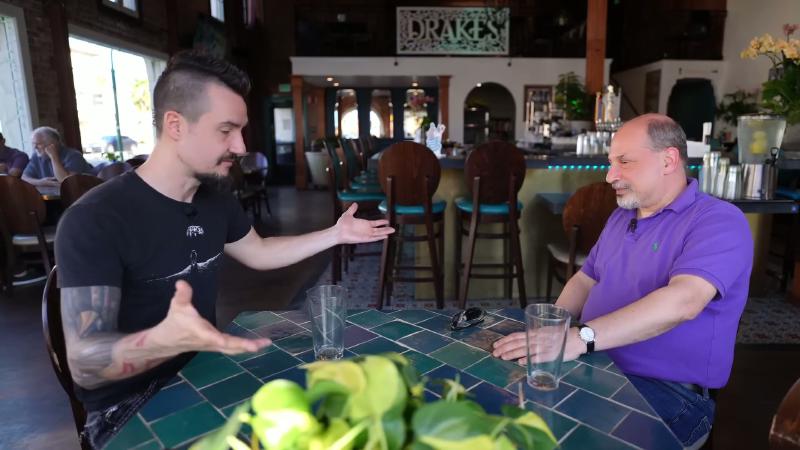
Wide conversation: empty glasses and folded sunglasses on the table; “DRAKE’S” lighting in the background; no Pattern Assignment slides—scene reference for that oral segment only.
B-roll and OCR noise: how not to misread the footage#
The main program is a bar interview with IDE B-roll intercuts. The frames below must not be read as carrier-class specification slides; captions bind OCR to visible pixels.
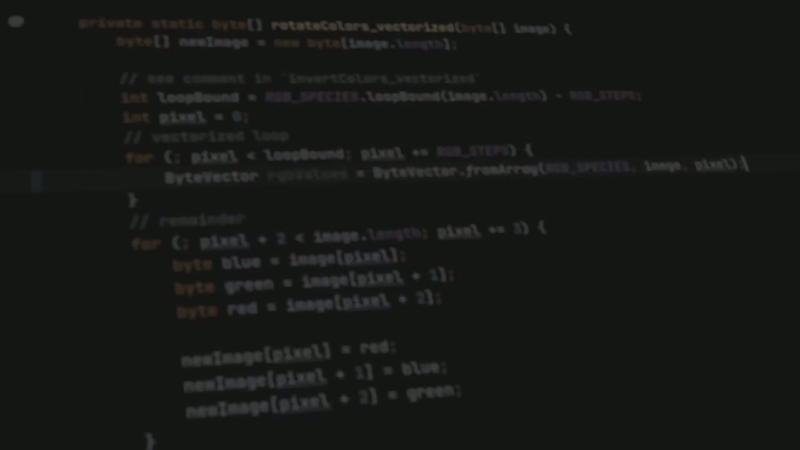
Dark IDE: OCR includes “Sytevecter .frestrrey ines OFECIES” and “eyte red = inagelpinel”; pixels show ByteVector and vectorized loops—a Vector API demo, unrelated to Amber type-header syntax.
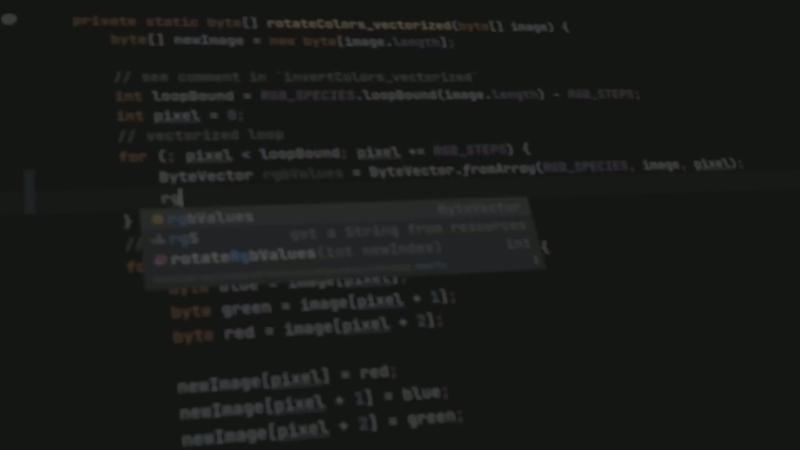
Another IDE frame: OCR “Sytevector ge veces = Bytetecter” and “neatnagetpinel * 21” overlaid on a completion list; still a SIMD color-rotation example.

Opening transition frame: nearly all black; no identifiable technical content—timeline placeholder only.
References and further reading#
- Inside Java Podcast 52 — Carrier Classes & Discussing Syntax
- Project Amber — goals, delivery list, and JEP status
- JEP 395 — Records (Delivered, Release 16)
- JEP 440 — Record Patterns (Delivered, Release 21)
- JEP 468 — Derived Record Creation (Candidate, Preview)
- JEP 12 — Preview Features mechanism
- JEP 465 — String Templates (Withdrawn)
- Beyond Records design notes (including reconstruction on hold)
- mail #1 — Data Oriented Programming, Beyond Records (2026-01-13)
- mail #2 — Beyond Records revision and deconstructible class (2026-02-25)
- Amber features 2026 — PATTERN ASSIGNMENT (2026-01-09)
- JLS 14.30.3 — determining unconditional patterns
- Towards Better Serialization — exploratory serialization design notes
- Towards Member Patterns — member-level pattern illustrations (non-final syntax)
- Beyond Records — Carrier interfaces section