

Getting Back to Java in 2026: A Modernization Path for Experienced Engineers#
If you stepped away from Java for a few years—or still equate “Java” with Java 8-era habits—what actually blocks you is usually not syntax but choice overload, release cadence, and the toolchain all changing at once. Many teams still follow an “if it compiles, ship it” upgrade strategy, then pay hidden costs in production: shifted GC defaults, tightened security APIs, inconsistent test-framework assertion styles, and more. The sections below are organized around engineering decisions: each explains the motivation, then the mechanism and constraints, a minimal actionable example, and common pitfalls. Comparative judgments that cannot be verified line-by-line against official documentation are labeled speaker opinion; where slide configuration keys disagree with official docs, official documentation wins and the difference is called out.
Artifact coordinates and auditable delivery#
Why#
Enterprise systems depend on third-party libraries for the long haul. Without a unified, searchable artifact repository, teams burn effort on “same name, different artifact,” missing checksums, and hard-to-audit private registries.
Mechanism and constraints#
Maven Central is operated by Sonatype. Publishing requires an explicit groupId, artifactId, and version triple, plus GPG signatures and checksums on published artifacts (see coordinate requirements). The same GAV on Central should resolve repeatably—this article did not find verbatim Central documentation stating “no overwriting the same version”; supply-chain governance still needs organizational dependency locking and SBOM practices.
How to#
<dependency>
  <groupId>org.slf4j</groupId>
  <artifactId>slf4j-api</artifactId>
  <version>2.0.16</version>
</dependency>
For the Gradle equivalent, see dependency management basics.
Common pitfalls#
- Treating “the package is on Central” as “the build is fully reproducible”—you still need locked plugin versions and recorded
mvnw/gradlewplus CI images. - Treating “more mature than other ecosystems” as a platform fact—speaker opinion; official docs discuss coordinates and signatures, not cross-language ecosystem rankings.
Choice burden in a plural ecosystem#
Why#
One of Java’s strengths is standards alongside implementations; the cost is that returners face a chain of decisions across build tools, cloud-native frameworks, and Jakarta EE runtimes—decision fatigue often called the agony of choice.
Mechanism and constraints#
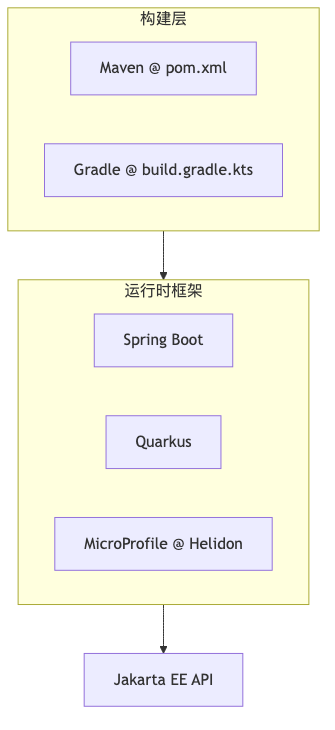
- Build: Maven, Gradle, and Bazel Java Rules can all serve as the backbone; teams usually follow existing repo conventions rather than picking “the strongest.”
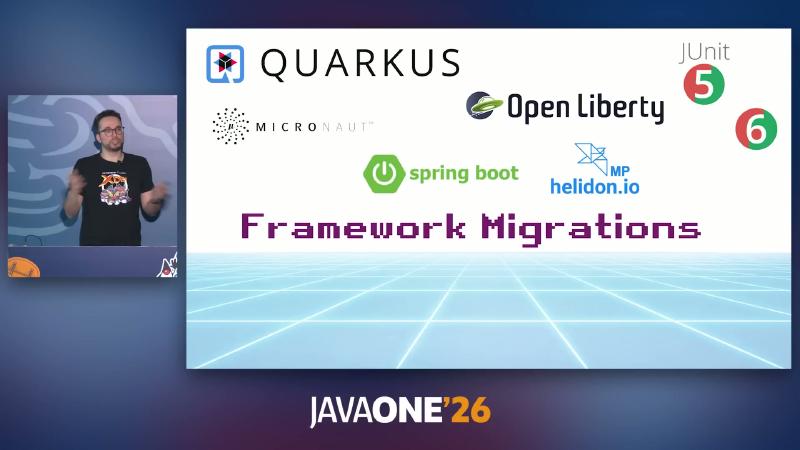
- Cloud-native frameworks: Helidon, Micronaut, Spring Boot, Quarkus, Open Liberty, and others coexist—speaker opinion (list); no single normative page enumerates them all at once.
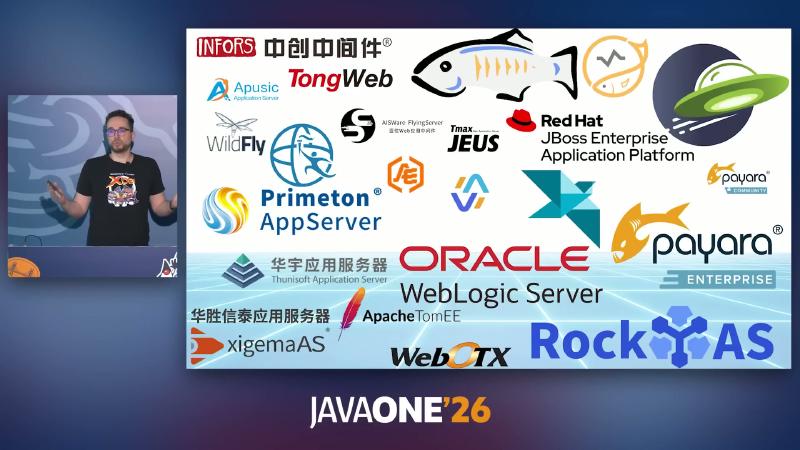
- Enterprise standard layer: Jakarta EE defines APIs; WildFly, Payara, Open Liberty, regional commercial middleware, and more are implementations (slides show a logo wall of that diversity).
How to#
For a new repository, align with the stack the team already uses; if you must evaluate, run a two-week spike on the same scenario (CRUD + DB + observability), not a leaderboard read-through.
Common pitfalls#
- Equating “many frameworks” with “must learn them all”—most teams need deep skill in one runtime plus awareness of migration paths.
- Ignoring the Jakarta namespace shift (
javax.*→jakarta.*) and its ripple through the dependency tree.
JDK distributions, the JVM, and Native Image#
Why#
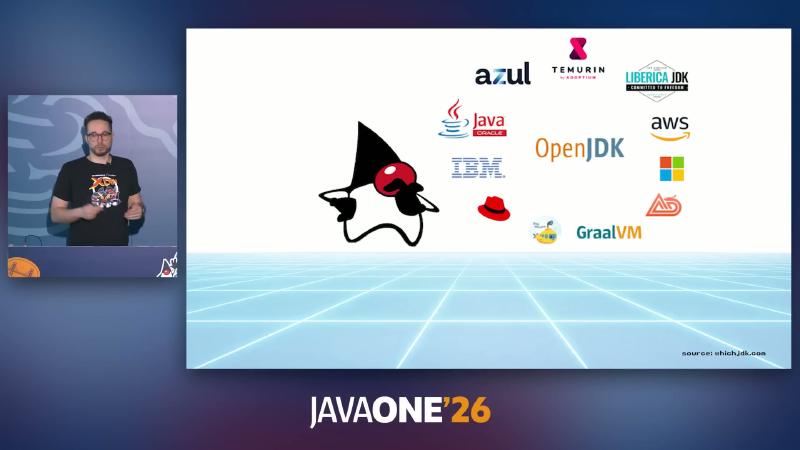
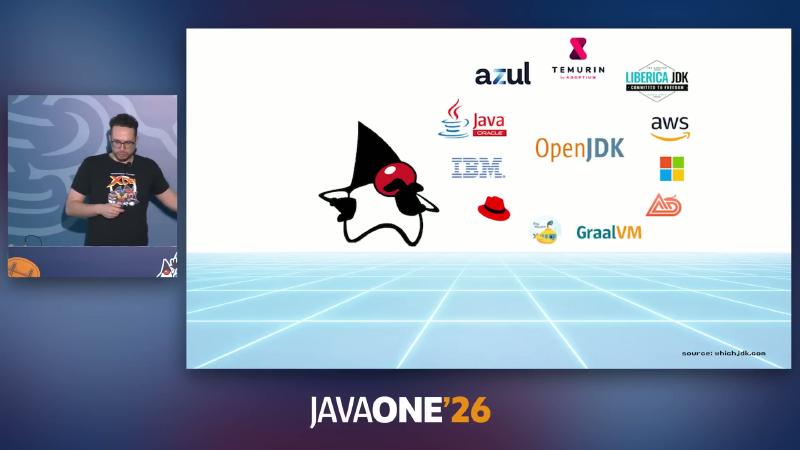
“Install Java” is still not enough in 2026: HotSpot and Eclipse OpenJ9 behave differently; cloud vendors and the community ship their own builds; some workloads also need AOT native images to cut cold start.
Mechanism and constraints#
- Language features enter OpenJDK through the JEP process.
- GraalVM Native Image documentation states: “Native Image is a technology to compile Java code ahead-of-time to a binary”; the CLI is
native-image. - Distribution choice can reference whichjdk.com (cited on slides).
How to#
# Conventional JAR
java -jar target/app.jar

# Native Image (requires GraalVM and reachability configuration)
native-image -jar target/app.jar -o target/app
./target/app
Common pitfalls#
- Defaulting every service to native compilation—reflection, dynamic proxies, and classpath scanning materially increase build and troubleshooting cost.
- Ignoring LTS and support contracts and choosing a JDK only because “the version number is largest” (see next section).
Six-month feature trains and two-year LTS#
Why#
A fixed cadence makes features predictable, but teams must separate “experimentation” from “production baseline” and understand preview API lifecycles.
Mechanism and constraints#
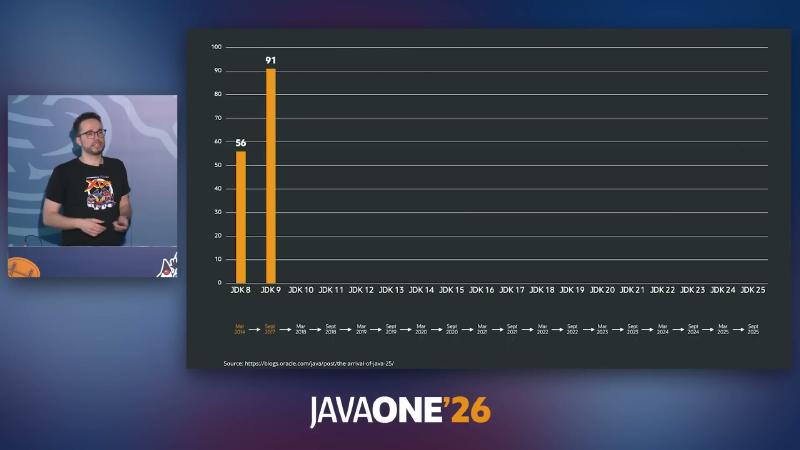
The OpenJDK JDK Project states: “The Project ships a feature release every six months”. The Oracle Java SE Support Roadmap notes LTS roughly every two years and lists Java SE 8, 11, 17, 21, and 25 are LTS releases; non-LTS releases are superseded by later releases. Preview features are off by default and require --enable-preview (JEP examples vary slightly by version).
How to#
# Try preview APIs (adjust version for target JDK)
javac --release 25 --enable-preview Hello.java
java --enable-preview Hello
Production should prefer LTS + a clear support window; non-LTS releases (e.g. Java 26 mentioned orally) suit experiments and CI matrices, not a company-wide default—Java 26 is not in the LTS sentence above. If you run long-lived servers, split “JDK upgrade” and “dependency upgrade” into separate pipelines: the former validates bytecode and the module system; the latter validates framework recipes and integration tests—avoid two regression classes in one release.
Common pitfalls#
- Skipping multiple LTS releases to chase the latest feature release, breaking dependencies and bytecode tooling at once.
- Building core business logic on preview APIs without a migration plan.
Simpler entry points: scripting and teaching scenarios#
Why#
Small automation, samples, and training should not be blocked by public static void main and a two-step compile; the language is reducing ceremony through JEPs.
Mechanism and constraints#
Evolution chain (do not pin to a single JDK):
| JEP | Version | Highlights |
|---|---|---|
| JEP 445 | 21 Preview | Unnamed classes, void main(), launch from source |
| JEP 477 | 23 | Implicitly declared classes, java.io.IO |
| JEP 495 | 24 | “Simple Source Files” terminology continues |
JEP 477 examples use println(...) after import static java.io.IO.*; slides write IO.println(...) and the qualified java.io.IO.println—semantically equivalent, with slight literal/layout differences from the JEP.
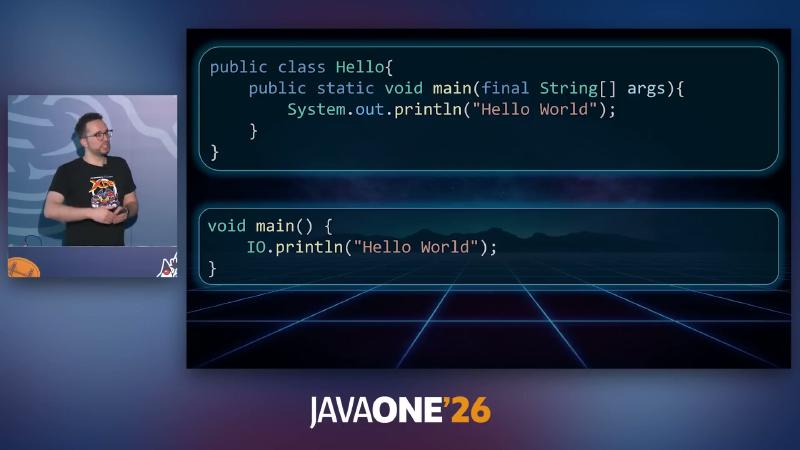
public static void main; bottom—void main() and IO.println contrast.
How to#
import static java.io.IO.*;

void main() {
    println("Hello World");
}
java --enable-preview Hello.java # follow target JDK JEP / release notes
Common pitfalls#
- Treating simplified entry as the default structure for Spring Boot services—enterprise code still needs modularity and explicit boundaries.
- Copying
--release 25examples while running on JDK 21, ignoring preview flags and API differences.
Virtual threads: scaling concurrency in a blocking model#
Why#
I/O-heavy services on platform thread pools hit thread count and memory limits; rewriting everything reactive raises cognitive and debugging cost. JEP 444 (Java 21, delivered) adds a lightweight thread abstraction while keeping imperative code.
Mechanism and constraints#
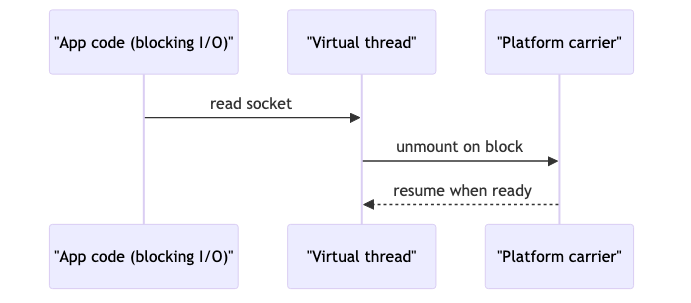
On blocking java.* I/O, the runtime issues non-blocking system calls and suspends the virtual thread so it unmounts from its carrier thread (JEP 444 terminology). Compatible with existing Thread APIs; pure CPU-saturated workloads may not gain throughput (JEP motivation).
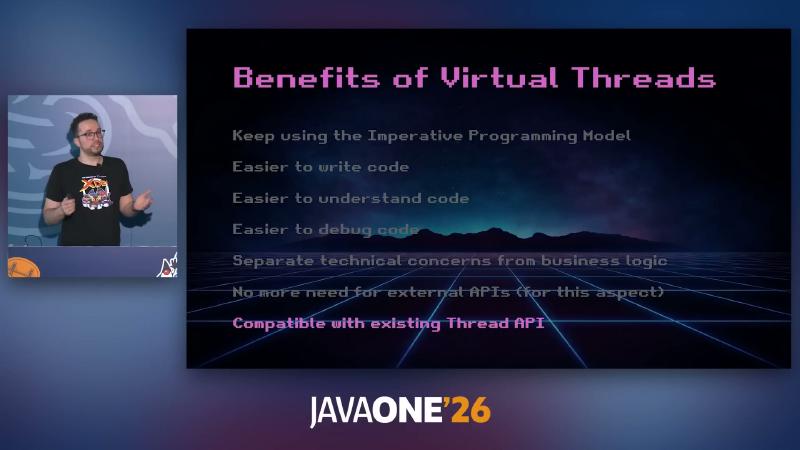
Spring Boot enables them via spring.threads.virtual.enabled (default false).
How to#
try (var executor = Executors.newVirtualThreadPerTaskExecutor()) {
    executor.submit(() -> {
        // blocking HTTP / JDBC
    });
}
spring.threads.virtual.enabled=true
Load testing can fire parallel requests and inspect stacks and latency (example):
seq 1 100 | xargs -n1 -P20 curl -s -o /dev/null http://localhost:8080/ping
Common pitfalls#
- Long blocking inside
synchronized, pinning the carrier thread (JEP 444 discusses such cases—read the current version). - Treating virtual threads as “free unlimited concurrency” while ignoring connection pools, downstream rate limits, and heap memory.
Cross-version differences: use lookup tools instead of memory#
Why#
Upgrading from Java 8/11/17, the time sink is API additions, removals, deprecations, and behavior changes—not syntax sugar alone.
Mechanism and constraints#
Community and official comparison sites (all HTTP-accessible; exact table headers on live sites):
- Java Version Almanac — API diff across versions
- Java Evolved
- dev.java — official learning path
- Inside Java — OpenJDK team news
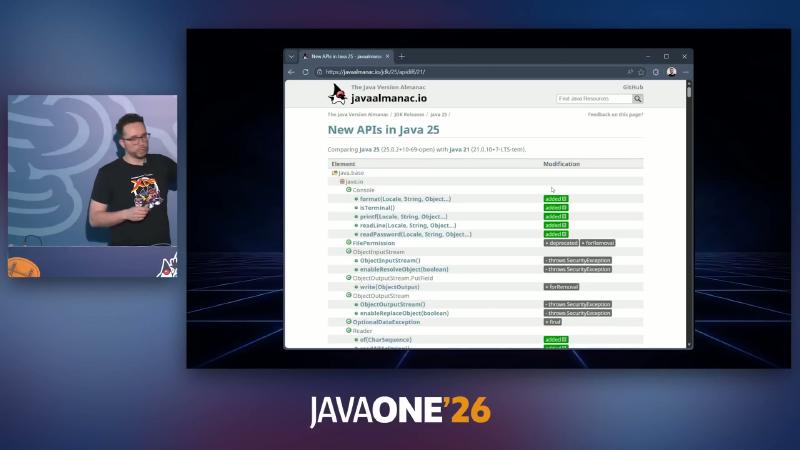
java.io package comparison between Java 25 and Java 21.
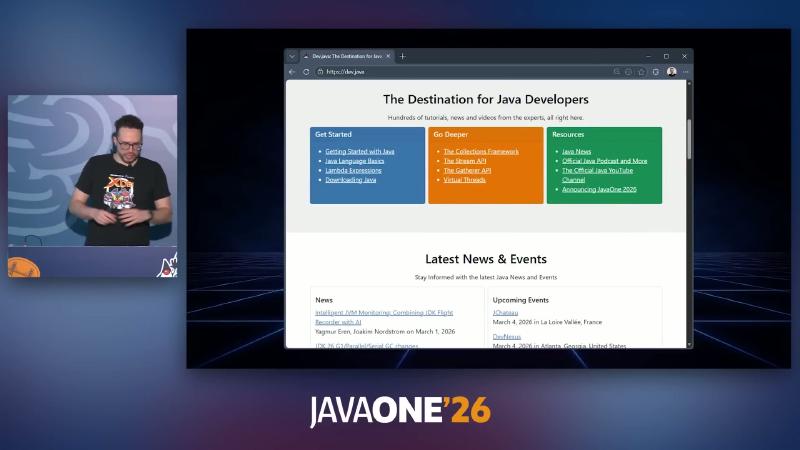
How to#
# CI gate: surface deprecations and suspicious usage at compile time
javac --release 25 -Xlint:all $(find src -name '*.java')
On the Almanac, pick from / to versions, filter packages you care about (e.g. java.base), and fold diff entries into an upgrade checklist.
Common pitfalls#
- Upgrading only the JDK, not dependencies—many breaks come from transitive dependency bytecode versions.
- Ignoring new throws such as
SecurityException(e.g. Almanac entries forObjectInputStream-related changes).
OpenRewrite: deterministic bulk migration with the LST#
Why#
JUnit 4→5, package renames, and framework upgrades by hand diff leak changes and do not scale to hundreds of repos.
Mechanism and constraints#
OpenRewrite uses a Lossless Semantic Tree (LST): relative to an AST, it emphasizes type attribution and format preservation (see LST concepts). Migrations are described by Recipes; Maven integrates via rewrite-maven-plugin.
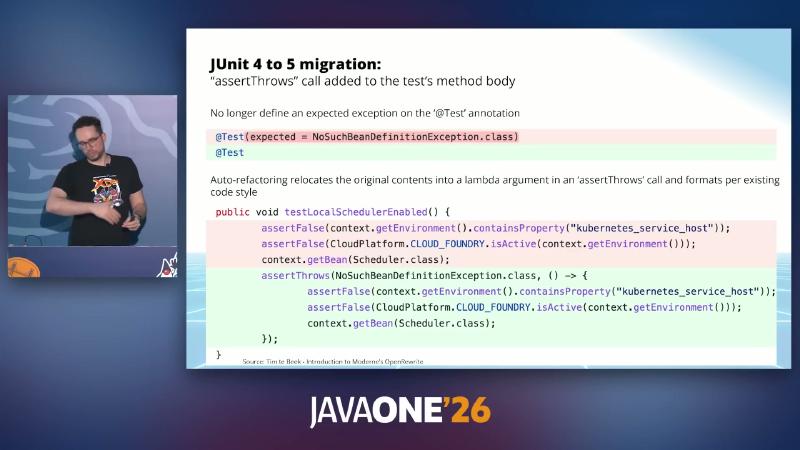
@Test(expected=…) moved into assertThrows in the method body; source Moderne OpenRewrite.
How to#
mvn -U org.openrewrite.maven:rewrite-maven-plugin:run \
  -Drewrite.activeRecipes=org.openrewrite.java.testing.junit5.JUnit4to5Migration
Post-migration test shape (Before/After semantics from Recipe docs):
@Test
void schedulerAbsent() {
    assertThrows(NoSuchBeanDefinitionException.class, () -> {
        context.getBean(Scheduler.class);
    });
}
Cross-framework Recipes: search by name in the Recipe catalog; do not invent IDs.
Common pitfalls#
- Running a Recipe without tests—LST format preservation does not mean full semantic coverage.
- Treating “framework logos on slides” as “one-click cross-migration”—most moves need phases and custom Recipes.
Local LLMs on the Java stack#
Why#
Experimental AI tied to a single cloud API blocks local dev and offline demos; Ollama exposes a local HTTP service, and Java integrates via Spring AI and Quarkus LangChain4j with unified model endpoint configuration.
Mechanism and constraints#
Spring AI (property table verified):
| Property | Default |
|---|---|
spring.ai.ollama.base-url | http://localhost:11434 |
spring.ai.ollama.chat.options.model | docs use mistral; can switch to llama3.2:1b |
Quarkus LangChain4j @ConfigMapping(prefix = "quarkus.langchain4j.ollama") places base-url under the ollama root, not under chat-model; prefer chat-model.model-id; model-name is a compatibility alias (config source).
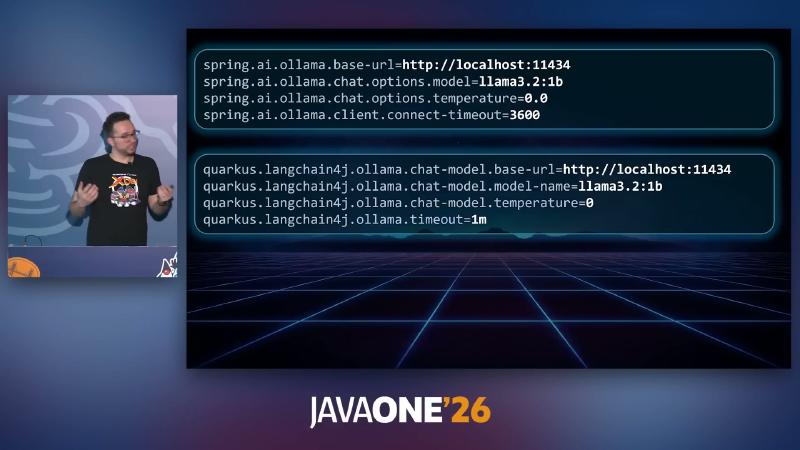
Slide draft used quarkus.langchain4j.ollama.chat-model.base-url — inconsistent with official quarkus.langchain4j.ollama.base-url; examples below follow official keys.
How to#
curl -s http://localhost:11434/api/tags | head
spring.ai.ollama.base-url=http://localhost:11434
spring.ai.ollama.chat.options.model=llama3.2:1b
spring.ai.ollama.chat.options.temperature=0.0
quarkus.langchain4j.ollama.base-url=http://localhost:11434
quarkus.langchain4j.ollama.chat-model.model-id=llama3.2:1b
@RestController
record ChatApi(org.springframework.ai.chat.client.ChatClient chatClient) {
    @GetMapping("/ai")
    String ask(@RequestParam String q) {
        return chatClient.prompt().user(q).call().content();
    }
}
Oral mentions of EclipseStore and Deep Netts — project docs not read for this article; unable to verify.
Common pitfalls#
- Copying slide Quarkus keys so configuration never binds at startup.
- No timeouts or concurrency limits—small local models under high load can stall a dev machine.
Shorter feedback loops: Dev Mode and the Leyden direction#
Why#
Modernization is not only new syntax; retention ties to “how fast do I see a change after editing one line.”
Mechanism and constraints#
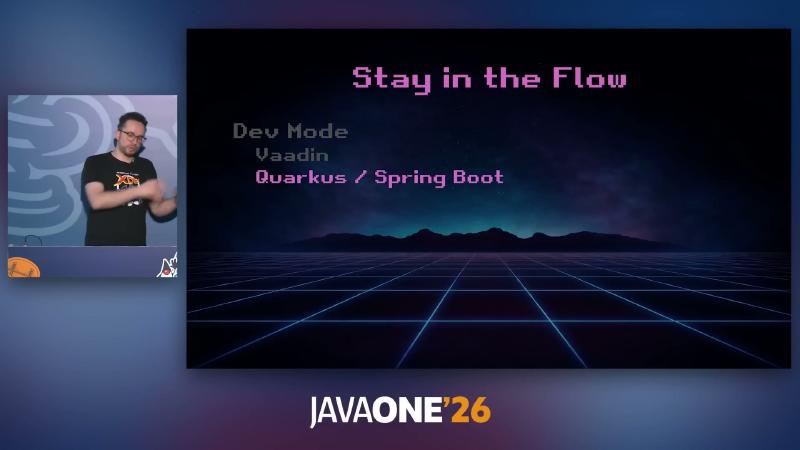
- Quarkus dev mode: “Dev mode enables hot deployment with background compilation”; entry
./mvnw quarkus:dev. - Spring Boot DevTools controls restart classloading via
spring.devtools.restart.enabledand related properties. - Project Leyden targets startup, warmup, and footprint; e.g. JEP 516 Ahead-of-Time Object Caching targets specific JDK delivery—do not write “AOT caching enabled by default for all apps.”
- JBR “enhanced class redefinition” — no verbatim JetBrains Runtime primary source captured here; unable to verify.
How to#
./mvnw quarkus:dev
spring.devtools.restart.enabled=true
Common pitfalls#
- Treating DevTools hot swap as a production feature—it is for the development classpath only.
- Conflating Leyden preview capabilities with GraalVM Native Image.
- Full container restarts instead of layered images and class-data-sharing tuning—Dev Mode solves coding phase, not cluster rollout.
Organization: modernization is people and process#
Why#
Full tooling can still fail: senior developers fear devalued experience; teams lack safe experimentation and documented contracts.
Mechanism and constraints#
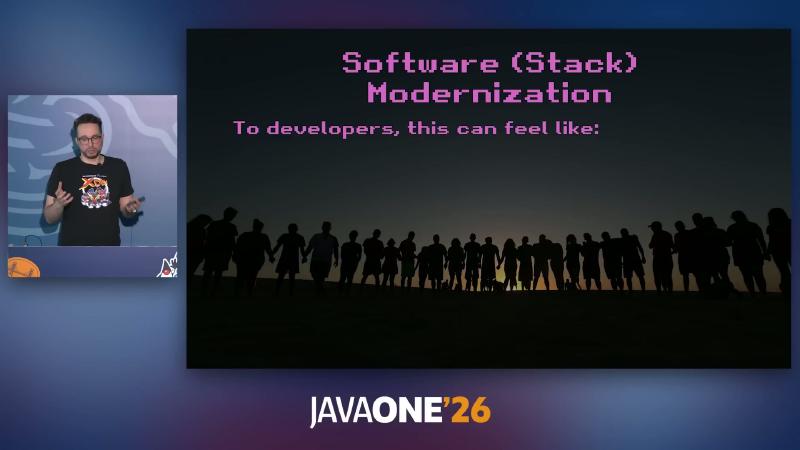
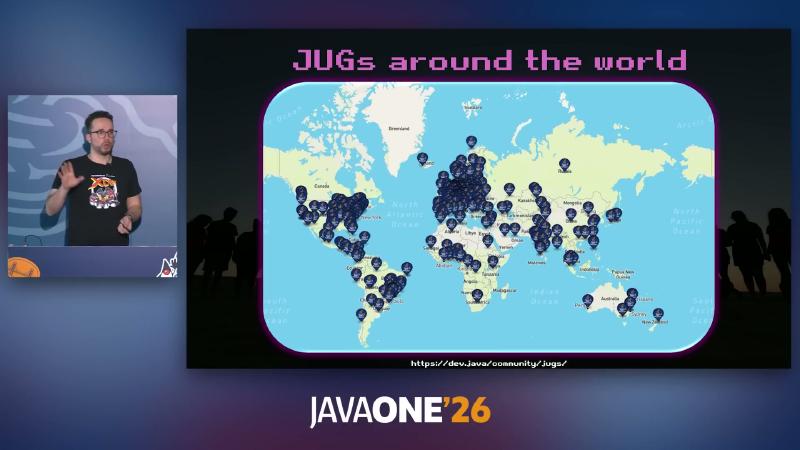
Speaker opinion: need safe space to experiment, README/AGENTS.md for build conventions, pairing (buddy), and faster local Maven builds. Tech debt often comes from psychological safety, not missing JEP links.
How to#
## Build
./mvnw -q verify
## Run
./mvnw spring-boot:run
git clone <repo> && cd <repo> && ./mvnw -q verify
Q&A on “AI expectation management” and “systems with a ten-year lifespan”—speaker opinion; no official normative page.
Common pitfalls#
- Buying tools without pairing and JUG participation—the community is implicit documentation.
- Citing external MCP benchmarks that “Java performs best”—unable to verify (no methodology or reproduction link).
References and further reading#
- Maven Central documentation portal
- Maven coordinate requirements (groupId / artifactId / version)
- Jakarta EE
- OpenJDK JEP index
- OpenJDK JDK Project (six-month release cadence)
- Oracle Java SE Support Roadmap (LTS / non-LTS)
- JEP 12: Preview Features
- JEP 444: Virtual Threads
- JEP 445 / 477 / 495: simplified source files and instance main
- GraalVM Native Image manual
- whichjdk.com — JDK selection reference
- Java Version Almanac
- dev.java developer portal
- Inside Java
- OpenRewrite docs and LST concepts
- JUnit4to5Migration Recipe
- Spring AI Ollama Chat configuration
- Quarkus LangChain4j extension docs
- Quarkus Maven tooling and dev mode
- Spring Boot DevTools
- Project Leyden and JEP 516
- dev.java Java User Groups map