

The JDK Desktop Client in 2026: Maintenance, Modernization, and Delivery on a Thirty-Year Stack#
In 1996, JDK 1.0 shipped with java.awt and java.applet. Thirty years later, browser Applets are history, yet Swing and AWT still power UIs in enterprise tools, IDE plugins, industrial control, and internal systems. In 2026, the OpenJDK Client Libraries Group is not trying to “invent another UI framework.” The focus is contract compatibility, platform change (Wayland, Metal/Vulkan/D3D graphics stacks), and a fixed six-month release cadence so existing applications remain buildable, deployable, and testable.
If you maintain Swing panels written a decade ago, watch three classes of change: removed symbols (Applet), packaging and native policy (jlink/jpackage, JEP 472), and OS display stacks (Wakefield). The sections below are organized around engineering decisions; roadmap details not in a JEP/CSR are labeled speaker opinion.
java.desktop: Layering in One Module and a “Maintenance-First” Posture#
Why module boundaries still matter#
Since JDK 9 modularity, AWT, Java 2D, Swing, javax.sound, Image I/O, and related APIs live in java.desktop. The official module description defines the user-interface toolkits for AWT and Swing, plus imaging, printing, sound, and media APIs. For operations and packaging, that means a pure server image can omit java.desktop in jlink to shrink size. For troubleshooting, Swing “lightweight” components still depend on underlying peers and Java 2D rendering—UI defects often require reading both javax.swing and java.awt.
Mechanism and constraints#
The typical layering is: java.awt for windows, events, and desktop integration; Java 2D for graphics, text, images, and printing (also used for headless server rendering); javax.swing built on both. The team’s public stance is that the API is largely feature-complete; new APIs mainly fill gaps or respond to ecosystem change. Current investment is in maintaining and modernizing implementations so legacy Swing apps run on modern desktops and coexist better with stacks such as JavaFX—speaker opinion, not a JEP constraint.
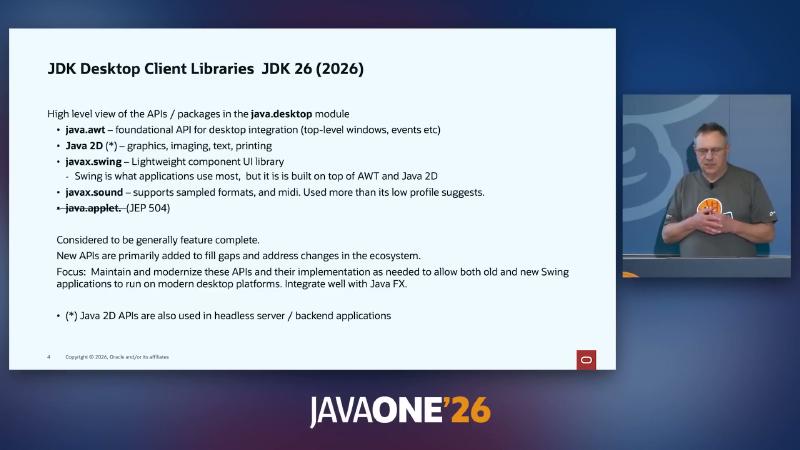
java.desktop module — java.applet struck through and annotated JEP 504
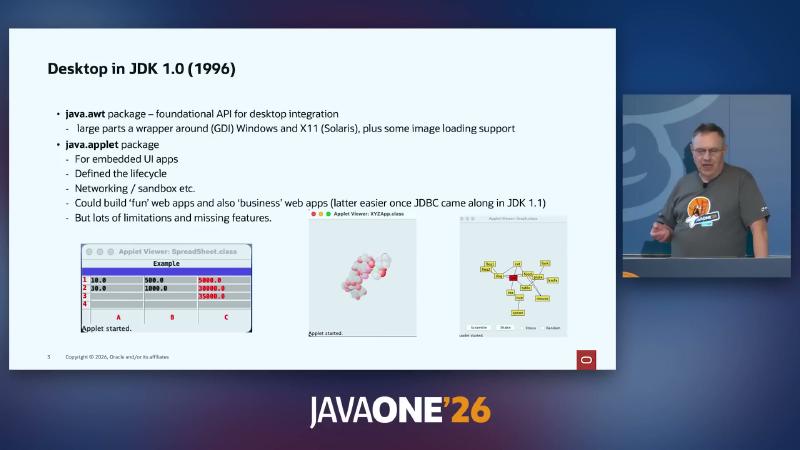
java.awt and java.applet
How to#
# Custom runtime for desktop-only applications
jlink --add-modules java.desktop --output ./jre-with-desktop
Common misconceptions#
- Misconception: Swing is dead, so AWT can be ignored.
Reality: L&F, drag-and-drop, clipboard, and multi-monitor still go through AWT. - Misconception: Removing
java.desktoponly affects GUI code.
Reality: Some imaging, font, and printing APIs also live in that module; headless scenarios need dependency-by-dependency review.
JEP 504: Applet Removal and the Desktop Delivery Model#
Why remove it completely now#
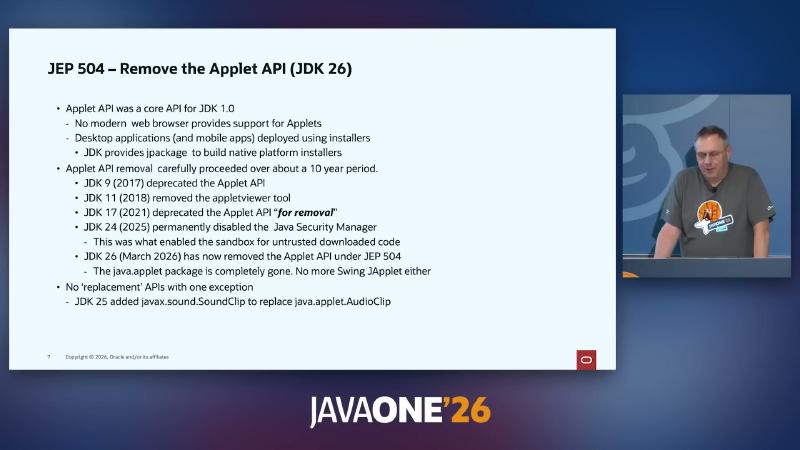
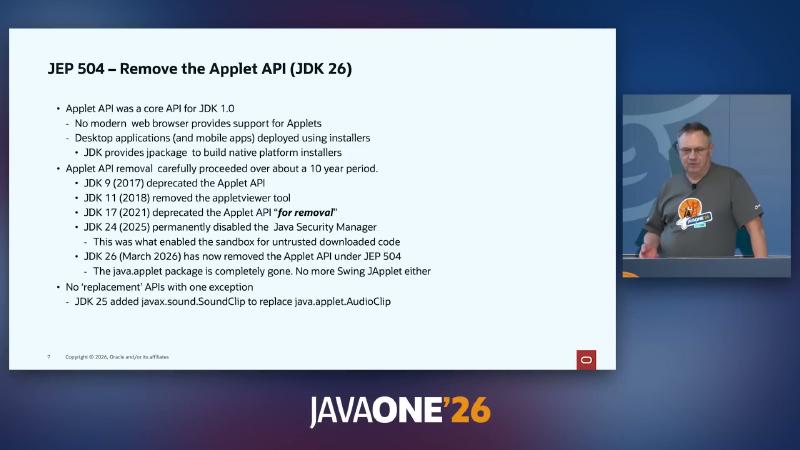
Modern browsers no longer run Applets; desktop and mobile apps ship as installers. JEP 504 (Release: 26, JDK 26 GA 2026-03-17) deletes the java.applet package (including Applet, AudioClip, and related types), javax.swing.JApplet, and associated references such as java.beans.AppletInitializer. The motivation chain connects to JEP 486 (JDK 24 permanently disables the Security Manager): Applet sandboxing depended on the SM; once the SM is disabled, that security model no longer applies.
Gradual timeline (JEP 504 and release notes): JDK 9 deprecated Applet APIs; JDK 11 removed appletviewer; JDK 17 marked APIs for removal; JDK 26 deletes them.
Mechanism and constraints#
Audio is one of the few corners with an official replacement: JDK 25 introduces javax.sound.SoundClip (createSoundClip, play, loop, etc.) as a stand-in for java.applet.AudioClip. Other capabilities have no one-to-one replacement API—you move to a standalone desktop process plus installer distribution.
How to#
// Old: java.applet.AudioClip — removed with the Applet API
// New: javax.sound.SoundClip (JDK 25+)
// SoundClip clip = SoundClip.createSoundClip(Path.of("ding.wav"));
// clip.play();
jpackage --type app-image --name MyApp --input dist --main-jar app.jar
Common misconceptions#
- Misconception: If you never used
JApplet, you are unaffected.
Reality: Scan for indirect references tojava.applettypes and legacy permission checks from the Applet era. - Misconception: Embedding Applet logic in a WebView is enough.
Reality: JEP 504 removes library symbols; plan for native apps or a web front end, not Applet lifecycle dependencies.
jlink + jpackage: Custom Runtimes and JavaFX Hybrid Packaging#
Why this is the default path after Applets#
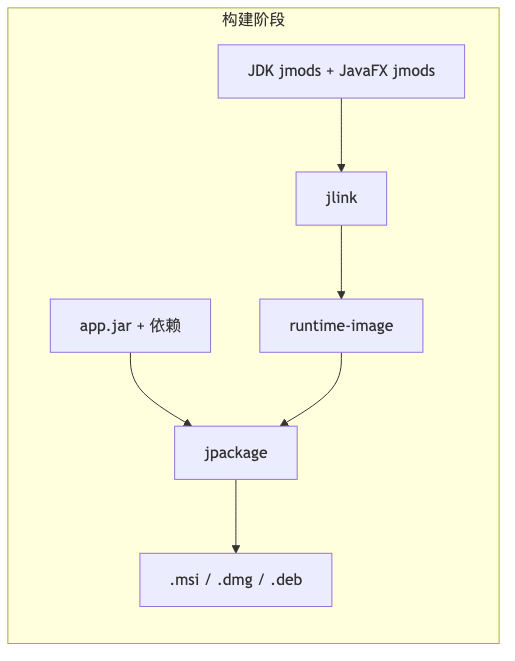
jpackage (bundled with the JDK since JDK 16) wraps application JARs and an optional runtime image from jlink into platform installers: Windows .msi/.exe, macOS .dmg/.pkg, Linux .deb/.rpm. For Swing + JavaFX hybrids, you must link JavaFX jmods together with JDK jmods and, on JDK 24+, handle native access policy.
Mechanism and constraints#
From JEP 472 (JDK 24), native access to JNI/FFM warns by default and must be enabled explicitly. The supported approach is runtime java --enable-native-access=..., or embedding the flag via jlink --add-options=...—not jlink --enable-native-access=... as a standalone jlink switch (draft notes sometimes conflate these; JEP 472 is authoritative).
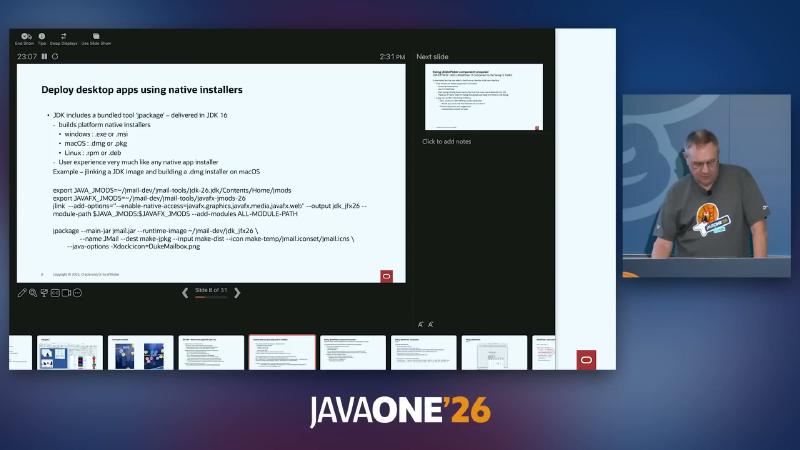
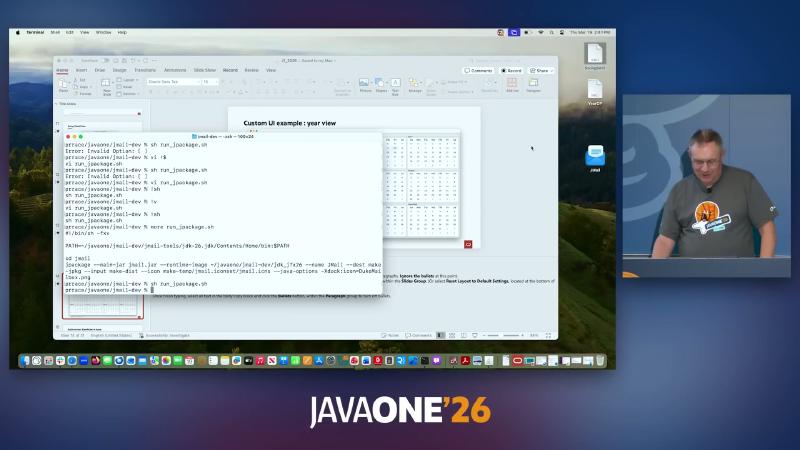
sh run_jpackage.sh and Invalid Option troubleshooting (live demo)
How to#
export JDK_MODS="$JAVA_HOME/jmods"
export JFX_MODS="/path/to/javafx-jmods"

jlink --output ./jdk_jfx_runtime \
  --module-path "$JDK_MODS:$JFX_MODS" \
  --add-modules java.desktop,javafx.controls \
  --add-options=--enable-native-access=javafx.graphics,javafx.media,javafx.web

jpackage --runtime-image ./jdk_jfx_runtime \
  --input ./dist --main-jar app.jar --name MyDesktopApp
In the demo, run_jpackage.sh failed with Invalid Option: [; the speaker fixed the script with vi !$ and reran—packaging pipelines are sensitive to quotes, brackets, and shell escaping. Prefer versioned build scripts (Maven/Gradle plugins or Makefile) over one-off manual commands.
Common misconceptions#
- Misconception:
jpackageautomatically pulls the full JDK.
Reality: Control the module set withjlink, or installer size balloons. - Misconception: Native warnings can be ignored.
Reality: JDK 24+ may restrict undeclared JNI; JavaFX graphics/media modules usually need--enable-native-access. - Misconception: A package built on macOS works on Linux CI as-is.
Reality: Installer formats and runtime images are platform-specific; runjpackageper OS (or ship anapp-imagewithout an installer and wrap it yourself).
Project Wakefield: Wayland, X11 Compatibility, and Robot#
Why the Linux desktop is a special battlefield#
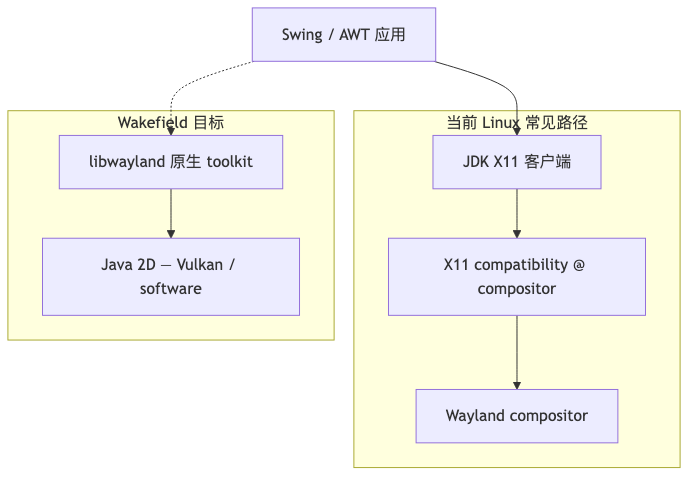
OpenJDK Project Wakefield aims to add Wayland support in the JDK. Today on Linux the JDK is still an X11 client; on distributions that default to Wayland, it relies on compositor-provided X11 compatibility mode (an X server embedded in the compositor; apps still open X connections). Slide wording: not completely seamless — not everything works and not everything in the same way.
java.awt.Robot (screenshots, synthetic input) had black-screen issues on pure XWayland paths (JDK-8246305). Later fixes include a Wayland screenshot path via dbus ScreenCast (org.freedesktop.portal.ScreenCast) (JDK-8335485, Fix Version includes 8/11/17 update pools) and relaxed Robot specifications in JDK 21 (JDK-8308012). Do not summarize this as “JDK 21 GA delivered everything at once”—check release notes for your exact update level.
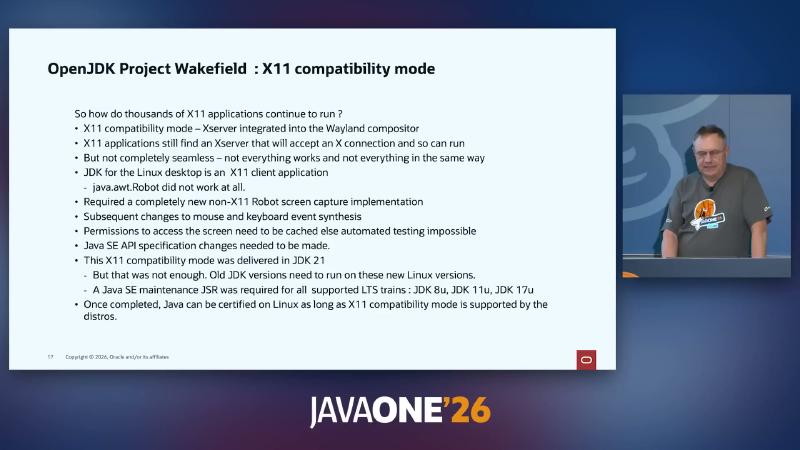
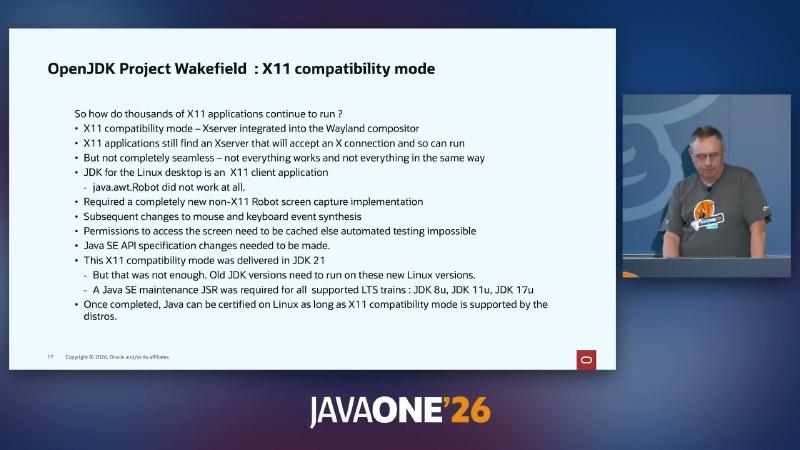
java.awt.Robot did not work at all — needs non-X11 implementation and spec changes
Native Wayland toolkit (roadmap)#
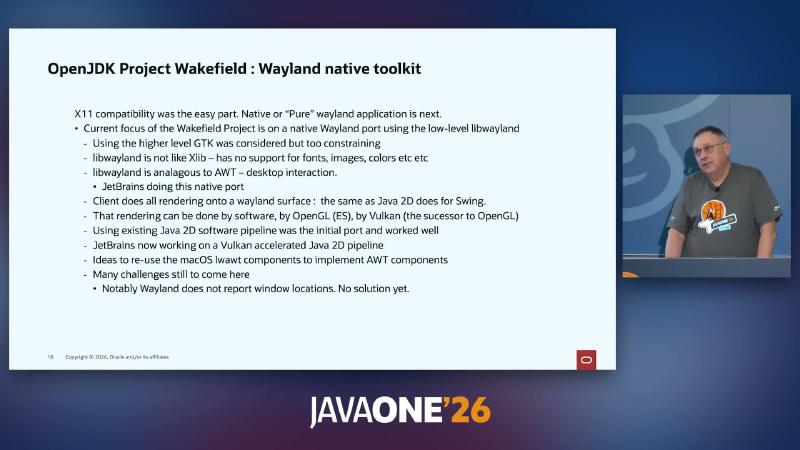
The next phase is a Wayland-native AWT toolkit: libwayland was chosen over GTK (the talk cites too many GTK constraints); rendering may use a software pipeline, OpenGL ES, or Vulkan (JetBrains involved in Vulkan-accelerated Java 2D, speaker opinion). Wayland does not report absolute window coordinates, which affects tests and multi-window logic that lay out relative to other windows—the slides say no solution yet.
How to#
Robot robot = new Robot();
BufferedImage shot = robot.createScreenCapture(
    new Rectangle(Toolkit.getDefaultToolkit().getScreenSize()));
# When troubleshooting, confirm session type and properties (property names per JDK-8335485)
echo "$XDG_SESSION_TYPE"
java -Dawt.robot.screenshotMethod=dbusScreencast -jar your-ui-tests.jar
Common misconceptions#
- Misconception: Installing Wayland means the JDK is Wayland-native.
Reality: Production paths still lean on XWayland; native work continues in separate pure Wayland experiments (speaker opinion; see the Wakefield project page for branch names). - Misconception:
Robotbehaves exactly like the spec from ten years ago.
Reality: CSRs were relaxed for permissions, compositors, and portal APIs; CI may need cached screen-recording permission or automation breaks on prompts (speaker opinion).
Swing JDatePicker: Gap-Filling APIs and Preview Boundaries#
Why propose date controls now#
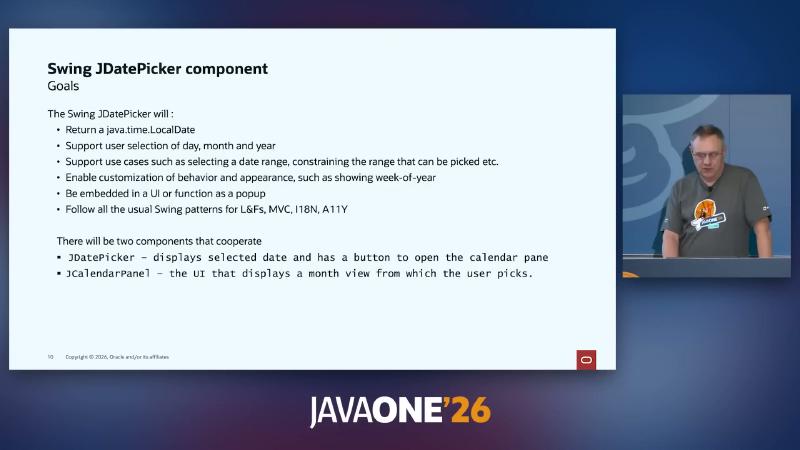
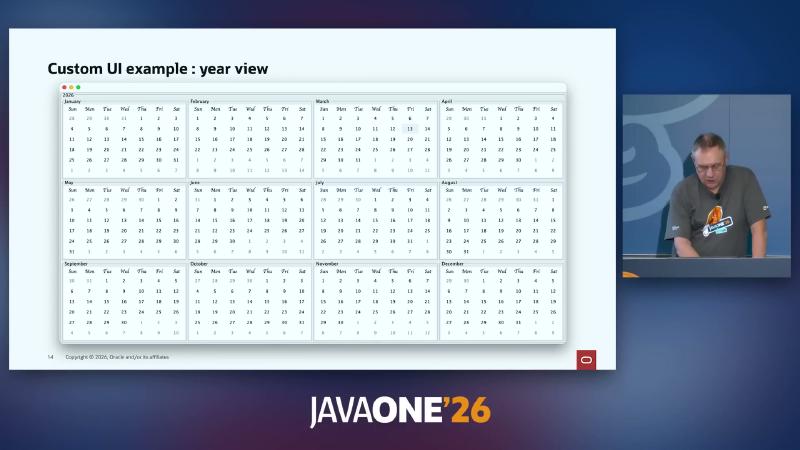
After years without new core Swing controls, the proposal adds JDatePicker (shows the selected date and opens a calendar) and JCalendarPanel (month view), returning java.time.LocalDate with L&F, MVC, I18N, and A11Y. Goals also include date ranges, optional range constraints, and week numbers. As of May 2026, the public JEP list has no JEP number for this work—treat it as preview API with an unverified GA schedule.
How to (sandbox trial)#
Speaker opinion: build and run from the JDK sandbox datepicker-preview branch; package names and APIs may change before GA.
// Pre-GA example — package names per sandbox
// JDatePicker picker = new JDatePicker();
// panel.add(picker);
// picker.addPropertyChangeListener("value", e ->
//     label.setText(String.valueOf(picker.getValue())));
Common misconceptions#
- Misconception: You can replace SwingX date widgets in production immediately.
Reality: Preview-branch APIs are unstable; wait for JEP/CSR freeze before migrating. - Misconception: You should still use
java.util.Date.
Reality: The new controls useLocalDate, aligned with thejava.timeecosystem.
Java 2D Pipelines: Metal, Vulkan, and Cross-Stack Reuse#
Why the graphics stack affects the whole desktop#
OS vendors are deprecating legacy graphics APIs: on macOS OpenGL is discouraged and the JDK has moved to Metal; on Linux OpenGL is fading and the Wakefield path treats Vulkan as a hardware-acceleration option (it may land on mainline before a full Wayland toolkit, speaker opinion); on Windows JavaFX is moving from D3D9 to D3D12, with the talk hoping to reuse results in JDK Java 2D, but D3D12 for the JDK has not started (speaker opinion; no matching public JEP verified here). The Linux production path remains X11 + XRender, parallel to Wayland window integration.
For application developers, performance and pixel-level consistency depend more on JRE updates and GPU drivers than on a few lines of Swing business logic. When upgrading JDK major versions, put font rendering, translucency, and large-canvas refresh on your regression checklist.
Common misconceptions#
- Misconception: Pipeline swaps are transparent with no regressions.
Reality: Run Java2D micro-benchmarks and visual regression on target OS/GPU; driver differences still cause defects. - Misconception: Vulkan landing means Wayland is done.
Reality: The two can advance independently—pipeline modernization ≠ finished window-system integration.
Panama FFM and ScopedValue: Pilots Beyond JNI#
Why the desktop module adopts FFM cautiously#
java.desktop contains extensive JNI (the talk cites 1500+ methods; count not verified line-by-line in public docs). A full rewrite is unrealistic; a pilot uses JEP 454 Foreign Function & Memory API to read OpenType font tables. Lessons from internal prototypes (speaker opinion): upcall binding to Java object handles is very expensive; JEP 446 ScopedValue passes context across downcall/upcall and partly replaces sun.misc.Unsafe; jextract was hesitated on because reading font tables needs callbacks into Java IO.
// Conceptual sketch — not OpenJDK source
private static final ScopedValue<ByteBuffer> FONT_SLICE =
    ScopedValue.newInstance();

ScopedValue.where(FONT_SLICE, buffer).run(() ->
    OpenTypeLib.readTablesNative());
Common misconceptions#
- Misconception: FFM can replace all JNI at zero cost.
Reality: Hot-path upcalls with object binding need deliberate design to reduce boundary crossings. - Misconception:
ScopedValueis the same asThreadLocal.
Reality: Semantics target structured concurrency and scoped lifetimes; misuse causes visibility/lifecycle bugs.
Technical Debt: Security Manager, AppContext, and De-finalization#
After JEP 486, much Applet sandbox and permission-check code in the desktop stack is dead and has been removed. AppContext is still slated for removal but more slowly—the talk says its semantics must be fully understood first; it affects thread grouping and assumptions in older libraries. De-finalization is a whole-JDK effort: the desktop still has leftovers in macOS CF retained objects and Java Sound (speaker opinion). New code should use try-with-resources / Cleaner, not Object.finalize().
Desktop UI Testing and the Six-Month Release Cadence#
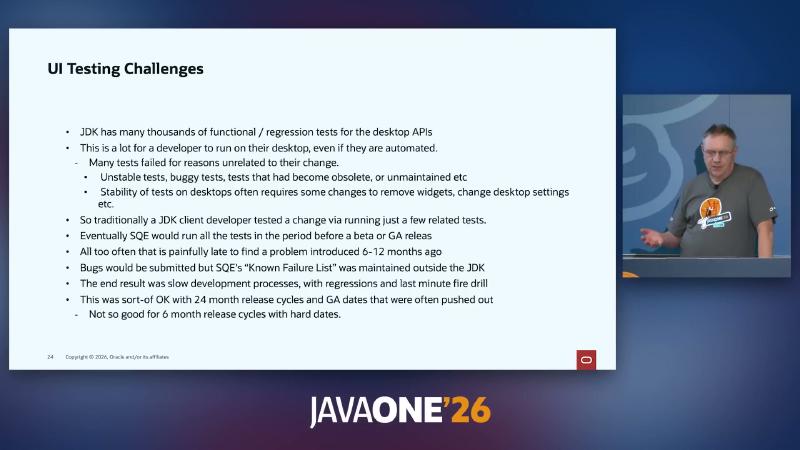
The desktop APIs have thousands of automated regression tests (slide OCR: JDK has many thousands of functional / regression tests for the desktop APIs). Historically, Known Failure List lag and SQE full runs meant regressions could surface 6–12 months later—Not so good for a JDK cadence with hard deadlines every six months (slide wording). The new strategy cuts red lights unrelated to the change at hand: flaky tests, stale assertions, unmaintained cases, and intermittent failures from desktop environment (dialogs, widgets, resolution).
Fixed six-month releases push Mach5-class CI (Oracle internal name, speaker opinion) toward all-green and favor physical machines over VMs to reduce vendor-desktop noise. Locally, developers should run only relevant subsets (jtreg/make targets depend on the JDK source tree); pipelines often use xvfb or headless configs, but that cannot fully replace focus and portal permission behavior on real hardware.
Common misconceptions#
- Misconception: All local failures come from your diff.
Reality: Flaky, outdated, or unmaintained tests have long existed; isolate the environment before blaming the change. - Misconception: Headless VMs equal real desktops.
Reality: Focus, compositors, and permission dialogs are first-class concerns in CI design.
Priorities and Future Pipeline (Clear Boundaries)#
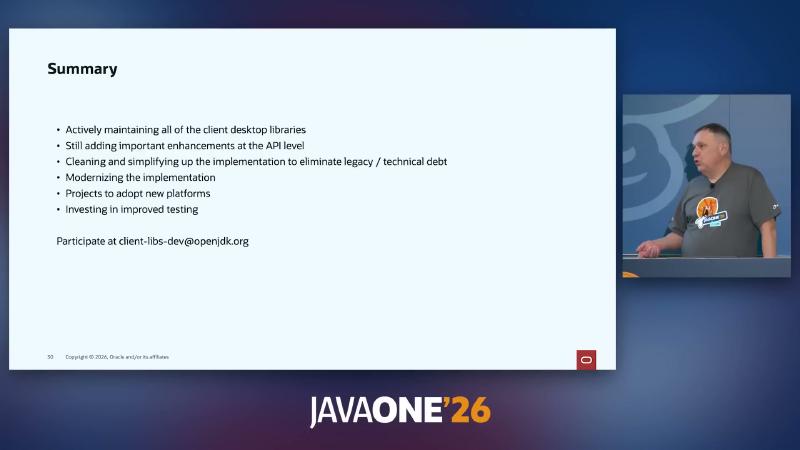
Work still in flight includes contract compatibility, critical defects, new platform adaptation, and third-party library upgrades. The pipeline covers OpenType font variations, native Wayland, more FFM, and JDK D3D12 (speaker opinion: not started). Vector API cannot be used in java.desktop implementations yet because java.desktop must not depend on incubator modules (the talk links this to Valhalla; no public JEP confirms a merge date). Q&A mentioned future Leyden/AOT artifacts might be packaged with jpackage, but generation/profiling should happen on the target platform (speaker opinion).
References and Further Reading#
- JEP 504: Remove the Applet API
- JDK 26 project and GA date
- JEP 486: Permanently Disable the Security Manager
javax.sound.SoundClipAPI (Java SE 25)jpackagecommand reference (Java SE 24)jlinkcommand reference- JEP 472: Prepare to Restrict the Use of JNI
java.desktopmodule summary- OpenJDK Project Wakefield
- JDK-8335485: Robot screenshots on Wayland
- JDK-8308012: Relax
java.awt.Robotspecification - JEP 454: Foreign Function & Memory API
- JEP 446: Scoped Values
- OpenJDK client-libs-dev mailing list
- Java SE 26 release notes (updated at GA)