

Spring for Apache Kafka 4: Migration, Share Groups, and the New Consumer Protocol#
Spring for Apache Kafka (Spring Kafka below) 4.0 ships with Spring Boot 4.0, bundles Kafka client 4.1 and Jackson 3, and on the client side integrates KIP-932 (Queues / Share Group) and KIP-848 (group.protocol=consumer). This article is organized around engineering decisions: a reproducible 3→4 migration first, then error handling that still applies on classic consumer groups, then the manual wiring boundaries for Share Groups, and finally opt-in adoption of the next-generation rebalance protocol.
Version note: Share consumers are marked preview / early access in the Spring Kafka 4.0 documentation; the
ShareAckModeenum andrenew()appear in the 4.1 docs. Where 4.0.x and 4.1 differ, that is called out below.
If you maintain a “Boot 3.5 + standalone spring-kafka 3.x” stack, the upgrade path can be summarized in three layers: dependencies and modular starters (Boot 4 BOM), serialization and test infrastructure (Jackson 3, KRaft embedded broker), and consumption model extensions (KIP-848 opt-in on classic groups, plus optional manual Share Group setup). The first two layers suit whole-application upgrades; the third should be chosen per workload, not enabled by default.
Migrating Boot 3→4 and Kafka 3→4 with OpenRewrite#
Why#
Hand-editing pom.xml, package names, and test annotations makes it easy to miss Jackson starter swaps or deprecated @EmbeddedKafka properties. OpenRewrite codifies repeatable AST-level changes as recipes, suitable for batch runs on a branch or in CI.
Mechanism and constraints#
Official recipes (verify in the rewrite-spring repository) include:
UpgradeSpringBoot_4_0— aggregates Boot 4.0 dependencies andMigrateToModularStartersMigrateAutoconfigurePackages— autoconfigure package path migrationUpgradeSpringKafka_4_0— e.g.JsonSerializer→JacksonJsonSerializer
The demo repository also includes custom recipes (e.g. MigrateSpringBootJsonToJacksonStarter, RemoveDeprecatedEmbeddedKafkaParameters) that are not in the official recipes.csv; you must maintain those yourself during migration.
How#
cd spring-kafka-3-to-4 && ./mvnw rewrite:run
In rewrite.yml, at minimum attach the official Boot/Kafka upgrade recipes, then add custom visitors as needed:
recipeList:
  - org.openrewrite.java.spring.boot4.UpgradeSpringBoot_4_0
  - org.openrewrite.java.spring.kafka.UpgradeSpringKafka_4_0
  # Demo repo custom (not official)
  - com.example.spring.kafka.RemoveDeprecatedEmbeddedKafkaParameters
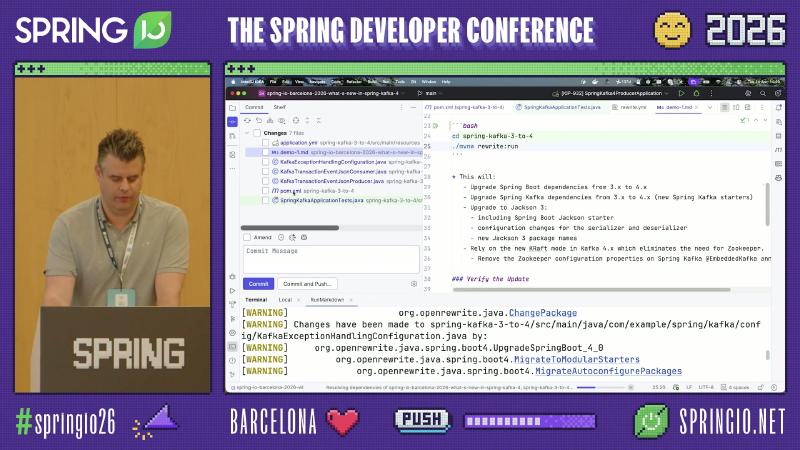
cd spring-kafka-3-to-4 and ./mvnw rewrite:run, with Upgrade Spring Boot / Spring Kafka recipe descriptions visible in the IDE.
Common pitfalls#
- Treating the demo’s
CustomUpgradeSpringkafka_4_0as the official recipe name — the official Kafka migration recipe isUpgradeSpringKafka_4_0. - Running OpenRewrite without running tests — ZK-related annotations and serializer changes still need test coverage.
- Running only the parent POM recipe in a multi-module monorepo — child modules that still declare
spring-kafkaversions directly may need per-module runs or supplementalChangeDependencyvisitors.
Modular starters and Jackson 3 serialization#
Why#
Boot 4 splits Kafka and JSON capabilities into dedicated starters and aligns with Jackson 3 (tools.jackson). Continuing to depend directly on spring-kafka + spring-boot-starter-json (Jackson 2) causes autoconfigure packages and serialization behavior to drift.
Mechanism and constraints#
| Before migration (illustrative) | After migration |
|---|---|
spring-kafka | spring-boot-starter-kafka |
spring-boot-starter-json | spring-boot-starter-jackson |
spring-kafka-test | spring-boot-starter-kafka-test |
JsonSerializer / JsonDeserializer are deprecated from 4.0 onward; use JacksonJsonSerializer / JacksonJsonDeserializer (based on Jackson 3’s JsonMapper).
How#
<dependency>
  <groupId>org.springframework.boot</groupId>
  <artifactId>spring-boot-starter-kafka</artifactId>
</dependency>
<dependency>
  <groupId>org.springframework.boot</groupId>
  <artifactId>spring-boot-starter-jackson</artifactId>
</dependency>
spring:
  kafka:
    producer:
      value-serializer: org.springframework.kafka.support.serializer.JacksonJsonSerializer
    consumer:
      value-deserializer: org.springframework.kafka.support.serializer.JacksonJsonDeserializer
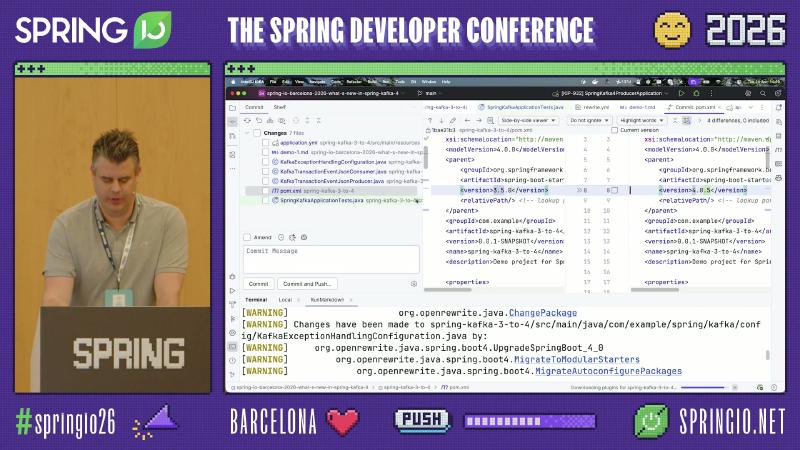
spring-kafka 3.5.0 and spring-boot-starter-kafka 4.0.5.
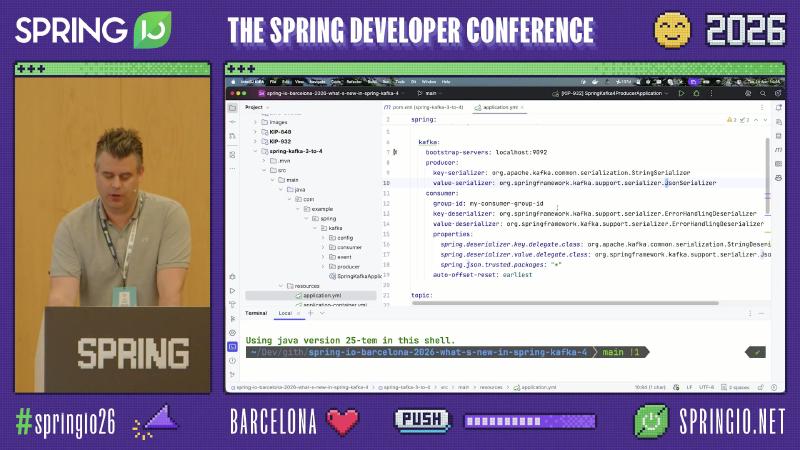
application.yml still using JsonSerializer and ErrorHandlingDeserializer delegate configuration.
Common pitfalls#
- Changing dependencies only, not serializer class names — runtime may still use the deprecated Jackson 2 adapter layer.
- Ignoring security-related properties such as
spring.json.trusted.packages— under Jackson 3 you still need to verify JSON trusted package configuration per What’s New. - Mixing third-party libraries bound to Jackson 2 — Boot 4 applications use Jackson 3 on the classpath; third-party starters that hard-depend on
com.fasterxml.jacksonneed separate compatibility review.
ErrorHandlingDeserializer still pairs with a JacksonJsonDeserializer delegate: the outer layer catches deserialization exceptions; the inner delegate is the Jackson 3 deserializer, so poison pills can be classified before they reach the listener.
@EmbeddedKafka and KRaft in tests#
Why#
Kafka 4 brokers support KRaft only; ZooKeeper is no longer used. Integration tests that keep zookeeperPort, kraft = false, and similar properties fail at embedded broker startup and no longer match production topology.
Mechanism and constraints#
Spring Kafka 4.0 What’s New removes zookeeperPort, zkConnectionTimeout, zkSessionTimeout, kraft, and related @EmbeddedKafka properties; the implementation is now EmbeddedKafkaKraftBroker.
How#
@SpringBootTest
@ActiveProfiles("test")
@EmbeddedKafka(partitions = 3)
class SpringKafkaApplicationTests { }
A custom OpenRewrite recipe can bulk-remove deprecated properties (as in the demo repository).
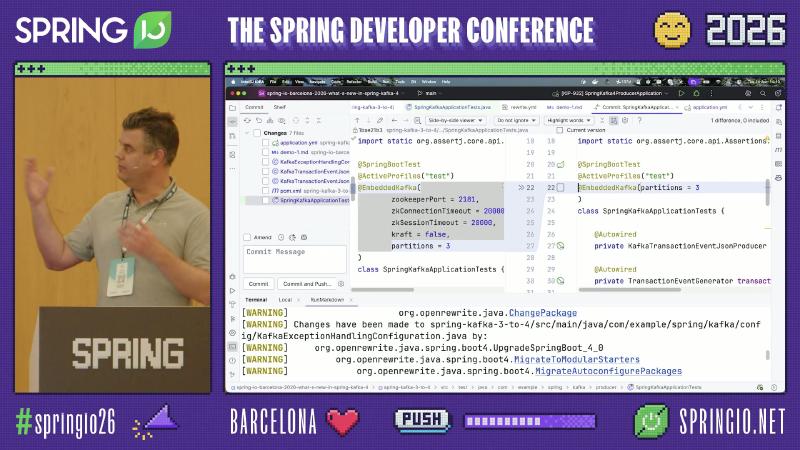
zookeeperPort = 2181, kraft = false versus streamlined @EmbeddedKafka(partitions = 3).
Common pitfalls#
- Assuming removing
kraft = falsemeans “turn off KRaft” — the effect is KRaft-only enforced. - Upgrading directly to Kafka 4 on production brokers still on ZK — unrelated to test annotations; that is broker upgrade scope.
Poison pills and DLT on classic consumer groups#
Why#
Messages that cannot be deserialized or fail permanently in business logic, if retried indefinitely within the group, stall partition progress for the entire group.id (head-of-line blocking). On classic consumer groups, Spring Kafka’s mature pattern is routing failed records to a Dead Letter Topic (DLT).
Mechanism and constraints#
DeadLetterPublishingRecoverer implements ConsumerRecordRecoverer, publishing failed ConsumerRecords to a DLT, often combined with ErrorHandlingDeserializer and DLT Strategies.
Boundary (speaker’s view, aligned with official documentation direction): Share Groups have no DLT story today; poison pills rely on reject(), delivery attempt limits, and other KIP-932 semantics — you cannot copy @RetryableTopic verbatim.
How#
@Configuration
class KafkaExceptionHandlingConfiguration {

  @Bean
  DeadLetterPublishingRecoverer recoverer(
      KafkaTemplate<?, ?> bytesKafkaTemplate,
      Map<Class<?>, KafkaTemplate<?, ?>> templates) {
    return new DeadLetterPublishingRecoverer(bytesKafkaTemplate, templates);
  }
}
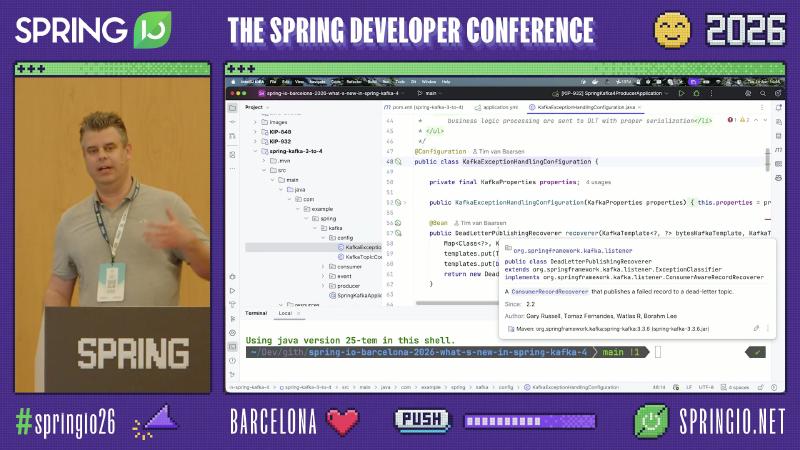
KafkaExceptionHandlingConfiguration with DeadLetterPublishingRecoverer bean definition.
Common pitfalls#
- Configuring a DLT recoverer on a Share consumer — official kafka-queues does not cover that combination.
- Not distinguishing deserialization failures from business failures — prefer
ErrorHandlingDeserializerfor the former; use recoverer / retry topic for the latter.
KIP-932: what Share Groups solve#
Why#
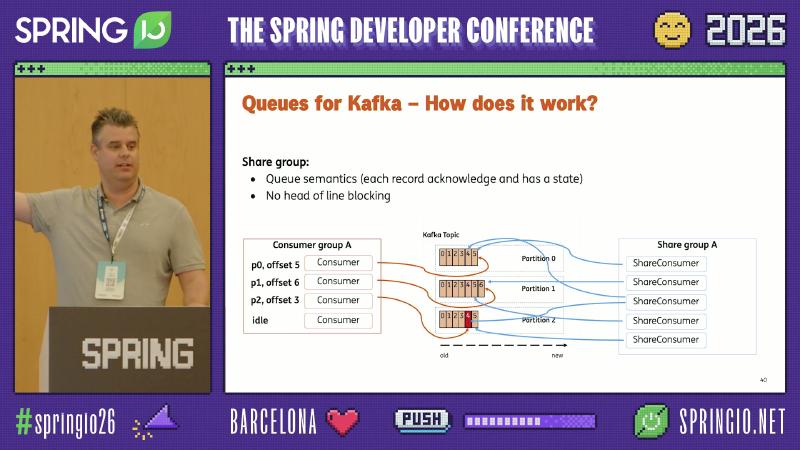
Under a classic consumer group, the number of active consumers is usually no greater than the partition count; a single slow message blocks the partition that consumer owns (partition-level head-of-line blocking). Under traffic spikes, teams often over-provision partitions just to gain horizontal scale.
KIP-932 introduces Share Groups: multiple ShareConsumers in the same share group can cooperate at record granularity, yielding queue-like semantics — per-record acknowledgment and release for retry by others.
Mechanism and constraints#
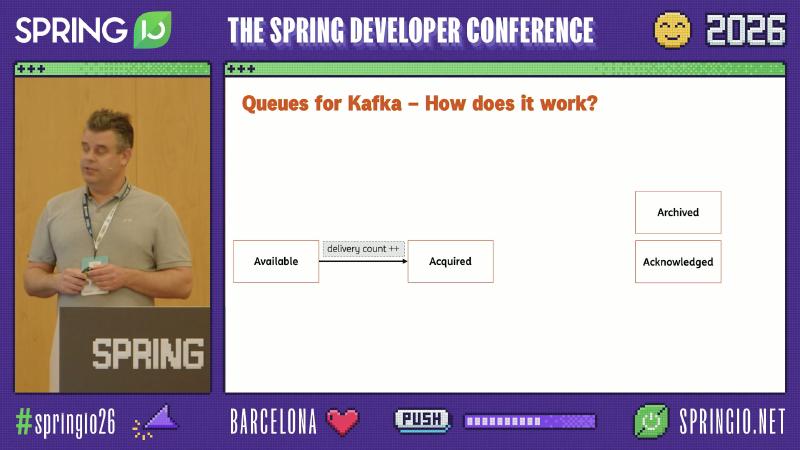
The broker maintains per-record state (KIP and Spring docs agree):
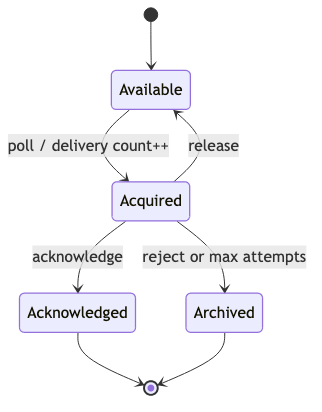
- Available → Acquired: delivery count increases when the consumer fetches (config name in KIP:
group.share.delivery.attempt.limit). - Acquired → Acknowledged: successful processing.
- release: temporary failure; another instance in the group can acquire again.
- reject: permanent failure; enters Archived (similar to discard / archive — not Spring DLT).
Speaker’s view (default values in this article not line-by-line verified against Kafka 4.1): roughly five delivery attempts and ~30s processing lock by default; Kafka 4.2 GA and Boot 4.1 were described as aligning in May — verify against your broker / BOM version. Boot 4.0 Release Notes state Kafka 4.1.0.
Unlike classic offset commits, Share consumption does not rely on “one logical position per partition” for progress; it relies on the broker’s per-record state machine. In operations, watch delivery count and Archived ratios, not only consumer lag (classic metrics may interpret share consumption differently — check monitoring docs for your Kafka version).
Common pitfalls#
- Treating Share Group as “consumer group with more partitions” — it does not guarantee order within a partition.
- Forcing Share where you need Kafka Streams, batch
@KafkaListener, regex topics, or static partition assignment — Spring docs list explicit non-support.
Manual wiring for Share consumers#
Why#
As of Spring Kafka 4.0 documentation, Share consumers are early access with no Boot autoconfiguration equivalent to spring.kafka.consumer.*. Without ShareKafkaListenerContainerFactory, listeners cannot create share containers correctly at runtime.
Mechanism and constraints#
Core types:
DefaultShareConsumerFactoryShareKafkaListenerContainerFactoryContainerProperties.setShareAcknowledgmentTimeout(Duration)— @since 4.0
4.0 vs 4.1: 4.0.x uses setExplicitShareAcknowledgment(true) for listener-side ShareAcknowledgment; 4.1 documents ShareAckMode.MANUAL. Demo code’s setShareAckMode targets 4.1; on 4.0.5 use the explicit flag instead.
Some classic ConsumerConfig keys are invalid for share groups — the minimal set is often just bootstrap.servers (as in the talk demo; see Kafka docs for the full list).
Speaker’s view: Micrometer tracing and metrics comparable to classic groups are still immature for Share scenarios.
How#
@Configuration
@EnableKafka
class ShareConsumerConfiguration {

  @Bean
  ShareConsumerFactory<String, TransactionEvent> shareConsumerFactory() {
  Map<String, Object> props = Map.of(
      ConsumerConfig.BOOTSTRAP_SERVERS_CONFIG, "localhost:9092");
    return new DefaultShareConsumerFactory<>(props);
  }

  @Bean
  ShareKafkaListenerContainerFactory<String, TransactionEvent>
      manualShareKafkaListenerContainerFactory(
          ShareConsumerFactory<String, TransactionEvent> factory) {
    var f = new ShareKafkaListenerContainerFactory<>(factory);
    f.setConcurrency(6);
    f.getContainerProperties().setShareAckMode(ShareAckMode.MANUAL); // 4.1+
    f.getContainerProperties()
        .setShareAcknowledgmentTimeout(Duration.ofSeconds(30));
    return f;
  }
}
4.0.x equivalent (without ShareAckMode):
f.getContainerProperties().setExplicitShareAcknowledgment(true);
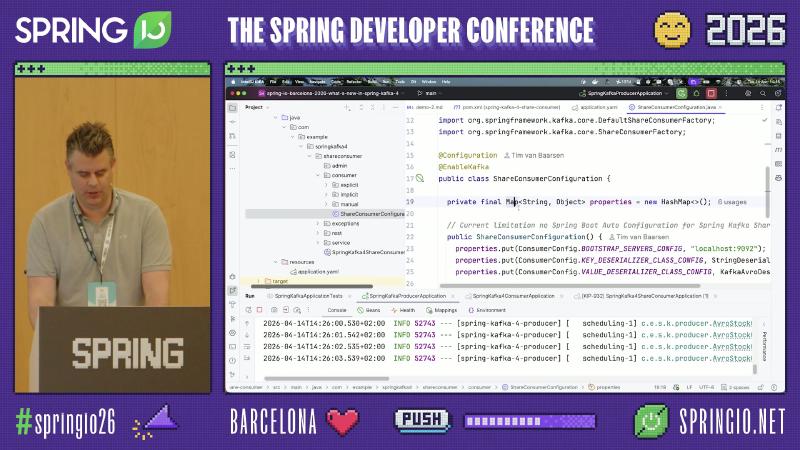
ShareConsumerConfiguration and DefaultShareConsumerFactory imports.
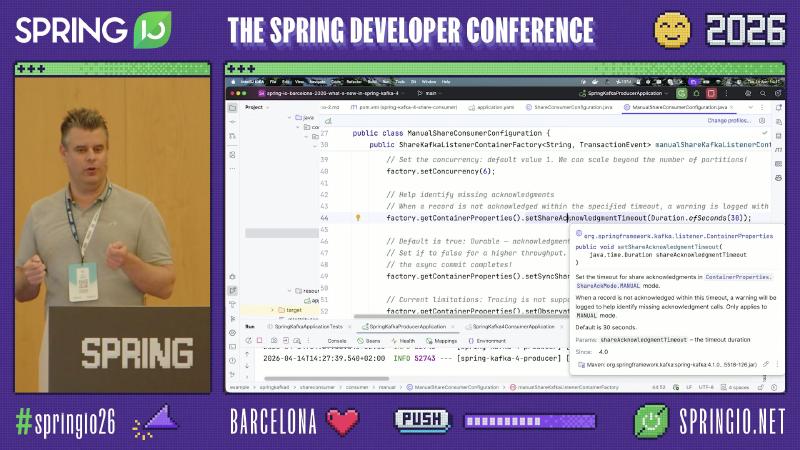
ManualShareConsumerConfiguration: ShareKafkaListenerContainerFactory, setConcurrency(6), ShareAckMode MANUAL.
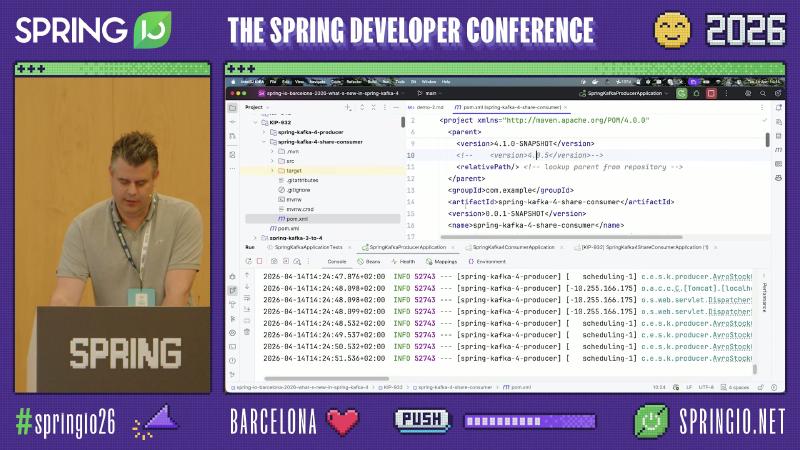
spring-kafka-4-producer and spring-kafka-4-share-consumer.
Common pitfalls#
- Adding
@KafkaListenerwithout declaringcontainerFactory— falls back to the classic container factory. - Treating
spring.kafka.listener.concurrencyas the only Share concurrency knob — share containers need separatesetConcurrency, with no classic hard cap tied to partition count (different cooperative consumption model).
ShareAcknowledgment: acknowledge, release, reject#
Why#
Work-queue scenarios must separate “downstream temporarily unavailable” from “permanently invalid for the business.” A single exception path cannot map precisely to KIP-932 release (retryable) vs reject (archive).
Mechanism and constraints#
| Method | Semantics (Javadoc) |
|---|---|
acknowledge() | Success |
release() | Temporary failure; can be consumed again within the group |
reject() | Permanent failure; no further delivery |
In explicit / MANUAL mode, unacknowledged records on the same thread block subsequent polls (Poll Constraints). In implicit mode, normal method return can trigger auto-ack — do not confuse with classic AckMode.
4.1+: ShareAcknowledgment.renew() extends the acquisition lock; default lock duration relates to group.share.record.lock.duration.ms (documentation example 30 seconds). Long-running work should plan for renew(), not only a larger timeout.
How#
@KafkaListener(
    id = "annotation-manual-transaction-event-processor",
    topics = "transaction-events",
    containerFactory = "manualShareKafkaListenerContainerFactory",
    groupId = "annotation-manual-group")
void handle(ConsumerRecord<String, TransactionEvent> record,
            ShareAcknowledgment ack) {
  try {
    service.process(record.value());
    ack.acknowledge();
  } catch (TransientException e) {
    ack.release();
  } catch (Exception e) {
    ack.reject();
  }
}
The demo also injects test events via HTTP POST /api/transactions (REST controller plus the listener above).
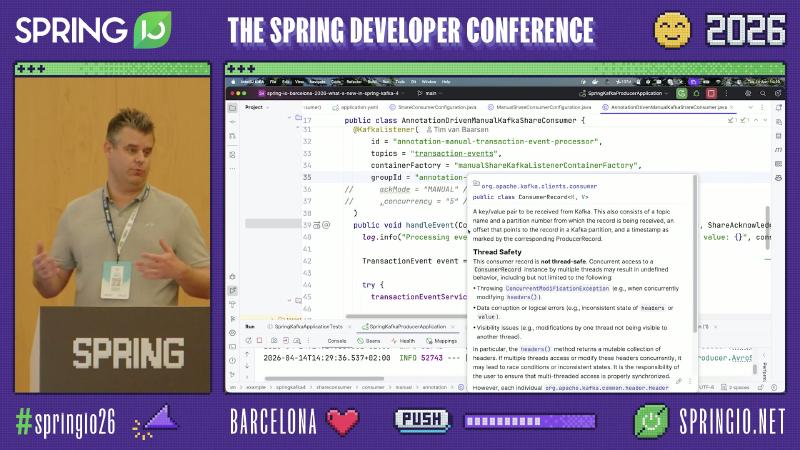
AnnotationDrivenManualKafkaShareConsumer: @KafkaListener with containerFactory = "manualShareKafkaListenerContainerFactory".
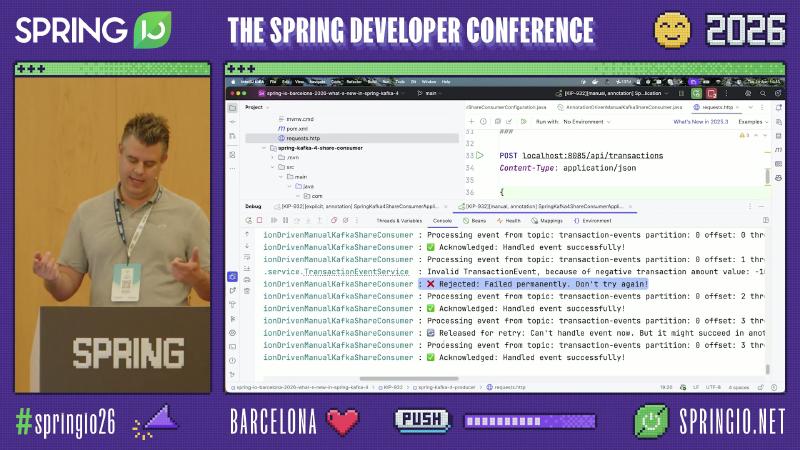
Acknowledged / Rejected / Released for retry.
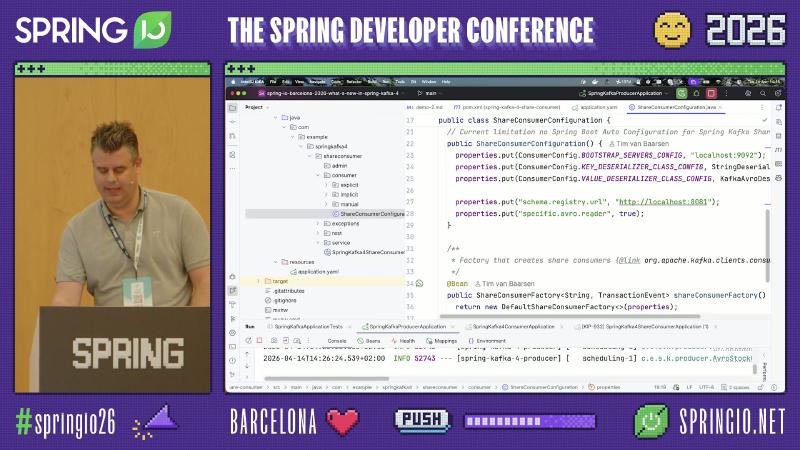
explicit, implicit, manual, and related examples side by side.
Common pitfalls#
- In MANUAL mode, neither calling ack nor expecting auto-commit — blocks consumption on the same thread.
- Treating
release()like classic consumer seek rewind — semantics re-enter Available for group competition, not a fixed partition offset. - Compiling with
ShareAckMode.MANUALon 4.0.5 — usesetExplicitShareAcknowledgment(true)instead.
Choosing Share Group vs. classic group#
| Dimension | Classic consumer group | Share Group |
|---|---|---|
| Parallelism vs. partitions | Consumers usually ≤ partition count | Can exceed partition count (record-level cooperation) |
| Ordering | In-partition order | Not guaranteed |
DLT / @RetryableTopic | Mature | Not yet (speaker summary + docs uncovered) |
| Boot autoconfiguration | spring.kafka.* | Manual factory required |
| Batch / regex topic / Streams | Supported | Listed as unsupported in docs |
| Observability | Relatively complete | Speaker’s view: metrics/tracing gaps remain |
If production depends on ordered event streams, Streams, batch listeners, or mature DLT, stay on classic groups. Share Group fits order-tolerant work queues that need multi-instance work stealing. Speaker’s view: share remains preview in current Spring Boot releases; production should wait for a Boot/Kafka combination aligned with Kafka Queues GA — confirm timing with official releases.
Before rollout, self-check: (1) Can you accept out-of-order delivery for the same key? (2) Is retry acceptable as “another instance takes over” rather than fixed-partition replay? (3) For permanent failure, is Archived acceptable instead of DLT audit? (4) Do monitoring and alerts cover share-specific metrics? If any answer is no, stay on classic groups and prioritize KIP-848 to reduce rebalance cost.
KIP-848: group.protocol=consumer#
Why#
Classic groups with many partitions and consumers can stall the whole group during rebalance, conflicting with K8s HPA and frequent rolling deploys. KIP-848 moves much assignment logic to the broker; consumers opt in via the new protocol.
Mechanism and constraints#
From Kafka client source (ConsumerConfig):
- Property:
group.protocol - Default:
classic - Valid values:
classic|consumer
Spring binding:
spring:
  kafka:
    consumer:
      properties:
        group.protocol: consumer
With consumer enabled, classic settings such as partition.assignment.strategy trigger ConfigException (consistent with custom PartitionAssignor no longer applying). Speaker’s view: quantify rebalance improvements from the KIP text; do not oversell “zero downtime” without version context.
This protocol applies only to classic consumer groups, not Share Groups (KIP-932).
How#
group.protocol=consumer
Ensure the broker has KIP-848 upgrade strategy enabled (bidirectional / upgrade cluster settings in the KIP — see KIP Case Studies).
Common pitfalls#
- Setting
group.protocolon a Share consumer — wrong path. - Keeping a custom assignor alongside the
consumerprotocol — fails at startup. - Using old Micrometer dashboards after upgrade — speaker’s view: broker metrics include
protocol=consumer|classicchanges; update alerts per the KIP. - Blue/green with two different
group.idvalues running the same logic — unrelated to protocol upgrade but can mask rebalance issues; migrate protocol under the samegroup.idwith rolling instances.
For Spring applications, ensure ConsumerFactory / @KafkaListener consumers ultimately include group.protocol=consumer; no Spring API change is required. To roll back, set the property back to classic and roll instances, provided your broker version still allows the downgrade path KIP-848 describes.
Rolling from classic to the consumer protocol#
Why#
Large consumer groups hesitate to change protocol for fear of a one-shot rebalance creating consumption gaps. KIP-848 documents rolling consumers for upgrade and downgrade.
Mechanism and constraints#
KIP-848 excerpt (direction verified):
“Upgrading to the new protocol or downgrading from it is possible by rolling the consumers”
Speaker’s view (not line-by-line verified against Kafka 4.1 broker source): you can temporarily mix classic and consumer instances; when the broker detects a new-protocol member joining, it migrates the group; then scale down classic instances; if old-protocol members return, rollback is possible. Speaker’s recommendation: end mixed-protocol operation quickly to avoid long-term dual-protocol broker overhead.

How#
The demo uses Docker Compose scaling (commands from live OCR; demo repository URL not independently verified):
docker compose -f docker-compose-applications.yml -p demo up -d
docker compose -f docker-compose-applications.yml -p demo \
  scale consumer-new-consumer-protocol=1
# After verifying group protocol switch, scale to 3 and retire classic instances
docker compose -f docker-compose-applications.yml -p demo \
  scale consumer-new-consumer-protocol=3
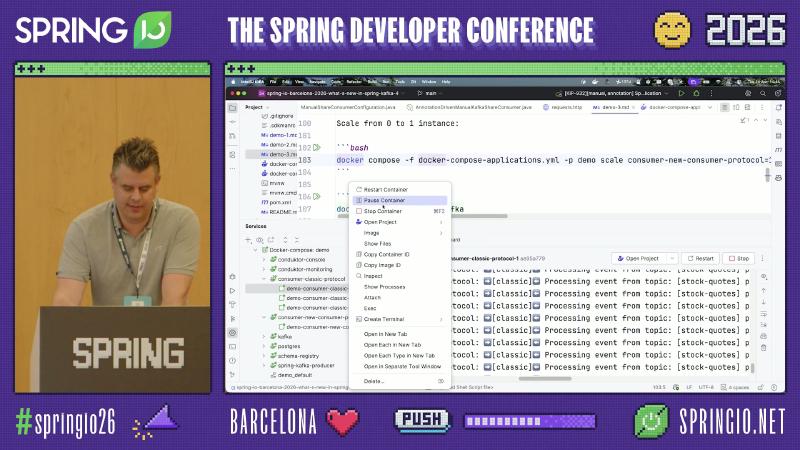
Scale from 0 to 1 instance and consumer-new-consumer-protocol.
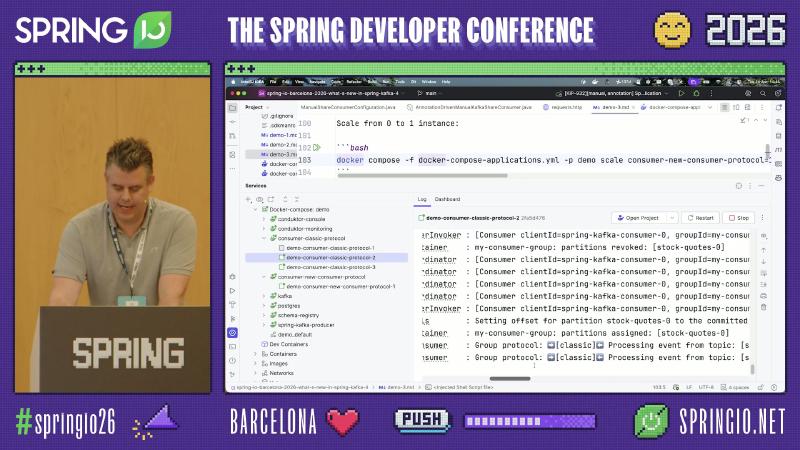
Scale from 0 to 1 and classic / consumer transitions in Group protocol logs.
Common pitfalls#
- Changing clients before broker upgrade / cluster upgrade strategy — undefined behavior or startup failure.
- Treating long-term mixed protocols as steady state — contrary to the KIP and the speaker’s recommendation.
References and further reading#
- Spring for Apache Kafka reference (4.0)
- Spring Kafka 4.0 — What’s New
- Spring Kafka 4.0 — Kafka Queues (Share Consumer)
- Spring Kafka 4.1 — ShareAckMode and renew()
- Spring Boot 4.0 — Release Notes
- Spring Boot 4.0 — Migration Guide (modular starters)
- Javadoc —
JacksonJsonSerializer - Javadoc —
@EmbeddedKafka - Javadoc —
DeadLetterPublishingRecoverer - Spring Kafka — DLT Strategies
- KIP-932: Queues for Kafka
- KIP-848: The Next Generation of the Consumer Rebalance Protocol
- Kafka
ConsumerConfigsource (group.protocoldefault) - OpenRewrite —
UpgradeSpringKafka_4_0recipe - OpenRewrite —
UpgradeSpringBoot_4_0recipe