

Structured Outputs: From Parseable JSON to Logit-Level Constrained Generation#
RAG pipelines, tool calling, evaluation scripts, and compound agents share one pain point: downstream code needs verifiable structure, while LLM default output is open text. The usual workaround is “return JSON only” in the prompt, then regex or a second model to extract—fine in demos, but in production it pushes failures to json.loads or business validation. Another path restricts legal tokens at every decoding step, so output stays inside a grammar/schema-defined set during generation; OpenAI Structured Outputs and Outlines represent product and open-source layers often lumped together, but the mechanisms differ.
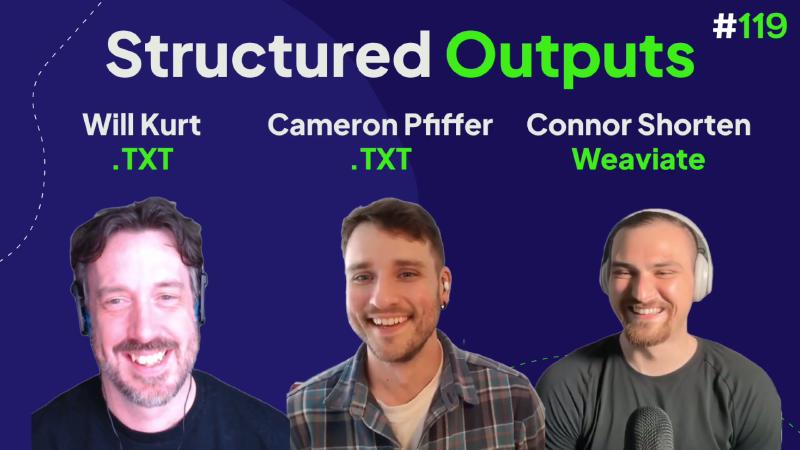
Below we separate structured outputs (application goal: parseable, storable) from structured generation (implementation: logit masking + finite-state machines). Mechanism sections follow Efficient Guided Generation (arXiv:2307.09702) and public Outlines Core design; performance and evaluation disputes are marked with verifiable boundaries and speaker views (dottxt co-founders Will Kurt and Cameron Pfiffer on the Weaviate Podcast—not reproduced in this environment).
Why you need generation-time constraints, not just post-hoc parsing#
Why: Agent orchestration, vector DB writes, and function-call argument passing all assume stable field names, types, and nesting. Parse-only-after-generation still allows valid natural language that is invalid JSON; fixes often mean another LLM call or a hand-written parser—latency and cost stack. OpenAI Cookbook on Structured Outputs stresses API-level JSON Schema compliance; self-hosted stacks usually attach a logits processor inside the inference engine (speaker view: Cameron treats even the loosest case as regex .*-level constraint—philosophically no truly “unstructured generation”—not formally proven; use as a conceptual frame).
Mechanism / constraints: Constrained decoding computes allowed tokens from the generated prefix each step, sets other logits to (-\infty), then samples; Outlines Logits Processors docs describe masking logits. vs “generate then validate,” failure moves from parse errors to “cannot enter illegal branches”—but if schema and task semantics mismatch, you can still get syntactically valid, semantically wrong output.
How to (minimal conceptual example):
# Pseudocode: each step allowed = index.allowed_tokens(state); logits[~allowed] = -inf
Pitfalls: Equating “the model said JSON” with structured generation; prompt constraints do not guarantee token-level validity. Another pitfall: assuming constraints are always slower—see coalescence and Willard et al. 2023 little overhead qualitative claim (no unified microsecond comparison table).

Finite-state machines: regex, grammar, and Index#
Why: JSON Schema, tool parameters, and classification labels compile to decidable token sequence sets; on a BPE vocabulary you must track “which automaton state we are in” to compute allowed_tokens efficiently.
Mechanism / constraints: Public path roughly: regex or grammar → Index (outlines-core README calls it finite-state automation / DFA) + Vocabulary (tokenizer/vocab alignment); each step next_state then allowed tokens. vLLM backend_outlines.py writes masks via Guide.write_mask_into. Speaker view (Cameron): implementation may go through NFA then determinization; current README does not spell out NFA→DFA step-by-step—partially verified. CFG is more expressive than regex; Outlines Output Types support Lark CFG; in practice JSON-like structures often use regex approximations or bounded unroll (recursion depth bound not given in the episode).

How to: Build Index with library-side regex / json_schema / CFG, register logits processor on self-hosted engine; do not replace FSM with ad-hoc “forbid }” rules.
Pitfalls: Thinking banning a character class (e.g. digits 0-9) bans numeric capability—speaker view (Cameron, demo-level): model may use Unicode superscripts etc., no systematic benchmark cited (P09, unable to verify). Another pitfall: CFG equals “any JSON Schema expressed exactly”—Coalescence blog notes not every valid JSON schema is one regex; engineering tradeoffs required.


Schema design: fix fields first, or let the model infer?#
Why: Production needs testable, versioned contracts; RAG extraction, ticket classification, and 10-K field mapping usually mean business already knows column names.
Mechanism / constraints: Fixed JSON Schema or Pydantic model → compile to FSM; dynamic function calling can generate runtime schema from Python signatures (speaker view, Will)—between rigid and fully inferred. Speaker view (Cameron): most cases should fix schema before downstream code; “see data first, let model propose schema” works but is volatile—no strong use case cited. Will adds: strong model can generate regex then feed Outlines—experimental.
How to:
from pydantic import BaseModel

class Ticket(BaseModel):
    summary: str
    department: str
    ticket_id: str
# outlines / vLLM: response_format or grammar bound to this schema
Pitfalls: Finer schema is always better. On last-letter-style tasks, speaker view (Will): hard-coding chain-of-thought templates in schema beats fully unstructured, but loses to constraining only the final answer with thinking fields free—“structure strength” is a hyperparameter. Another pitfall: ignoring field dependencies; multiple fields in one JSON let later keys “see” earlier text (compound tasks below), unlike “one API call per field.”
Coalescence: deterministic segments and speed claims#
Why: Many JSON tokens are highly predictable (e.g. " after {); full sampling each step spends compute on low-entropy spans.
Mechanism / constraints: Coalescence: making LLM inference 5x faster (Will Kurt): when FSM marks a segment deterministic, skip sampling and advance state; based on regex–FSM equivalence. Speaker view (Will): about 2–3×+; blog title/body say ~5×—not benchmarked side-by-side here; cite both with boundaries in prose.
How to: Use Outlines / inference stack versions that support coalescence; do not assume all vLLM builds enable it by default.
Pitfalls: Equating coalescence with “constraints always reduce latency”; speed depends on predictable schema fraction. Another pitfall: mixing with token-granularity hypotheses—speaker view (P10): single-token dog vs D+O+G paths may differ in probability; smaller-token bias “has papers” but titles not given (unable to verify); coalescence favoring “longer paths” is unpublished pre-research.

Inference stack integration: vLLM, xgrammar, Outlines Core#
Why: Constrained decoding must run inside the vocab-aligned inference process; mask/tokenizer mismatch causes illegal output or deadlock.
Mechanism / constraints: vLLM Structured Outputs supports multiple backends; StructuredOutputsConfig.backend includes auto, xgrammar, guidance, outlines, etc. auto in sampling_params.py often tries xgrammar first, then falls back to guidance or outlines (not always Outlines). Speaker view (Cameron): medium features like inline regex fall back to Outlines; vLLM bundles “old Python Outlines”—conflicts with narrative that main now uses outlines_core (Rust)—partially conflicting; trust deployed version README.
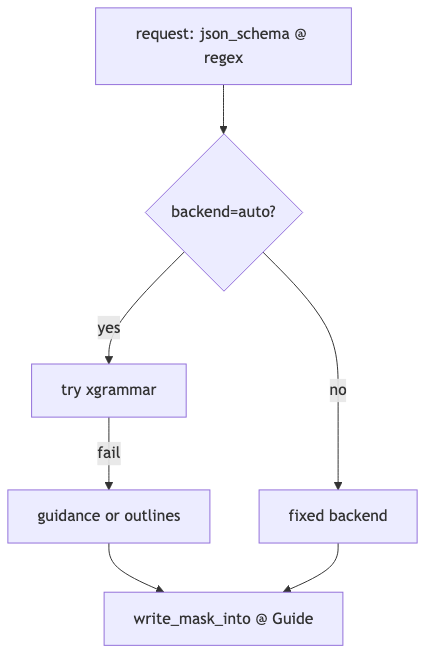
How to: In production, set backend explicitly and pin vLLM / outlines-core versions; for DeepSeek-R1 and similar reasoning models, vLLM Reasoning Outputs allows json/regex on the answer segment—speaker view (Cameron): sealing entire JSON including think hurts reasoning; keep think free text, constrain final answer only (mechanism plausible; gist URL not verified).
Pitfalls: Assuming hosted API Structured Outputs and self-hosted logit constraints are interchangeable in eval. Ignoring xgrammar vs Outlines schema feature gaps causing silent fallback.


Quality debate: do format constraints hurt reasoning?#
Why: Selection must answer “does adding structure drop scores?”; conclusions from non-comparable evals skew engineering choices.
Mechanism / constraints: Let Me Speak Freely? (arXiv:2408.02442) (Tam et al.) abstract: format limits significantly reduce LLM reasoning; free text beats constrained format on GSM8K etc. (literature-supported). §3.3 uses LLM to extract final answers on unstructured branch (appendix picks Claude etc. as extractors)—literature-supported. Speaker view (Will): disagrees with dottxt GSM8K eval, suspects prompt, parse path, second-LLM cost asymmetry; accepts paper’s engineering angle on hand parsers vs constrained decoding. Same model “output JSON” vs no Outlines: some collapse, some improve (speaker view)—eval should fix prompt × model × parser triple.
How to: When reproducing disputes, report: constrained stack, schema char/token budget, external LLM parsing. Speaker view (Will, P07): GSM8K structured reasoning steps with too-tight char cap lose to baseline first; widen and can beat baseline—no public table, unable to verify.
Pitfalls: One paper dismissing all constrained decoding. Using Berkeley Function Calling Leaderboard format details (e.g. float must have .0) as main evidence—speaker view calls it unfair; BFCL rule not located in source this round (interview view until located).


Distribution mismatch and “one generation, many fields”#
Why: Intuition says internet corpora are not JSON-like, so constraints are OOD; guests counter that email, tweets, tags are structured—the issue is constraint strength vs task fit (speaker view, consensus-level).
Mechanism / constraints: Real risk is mask removing high-probability token paths → local distribution shift—research gap (speaker view); DeepLearning.AI course example claims forcing { "name": aligns local conditional distribution with unconstrained (not reproduced here). On compound tasks, speaker view (Will/Cameron): one structured JSON for summary, department, ticket id, etc. often beats multi-step pipelines—field self-context, less prefill; Connor cites multi-task inference paper, title not in subtitles (unable to verify).
Pitfalls: Applying software-engineering “small functions” directly to LLMs—modular human-code arguments often fail here (speaker view). Another pitfall: lengthening context for multi-turn chat while ignoring reliability and streaming early to downstream (Cameron stresses agents as composable tools, not chat-turn races—speaker view).


Agents and compound systems: JSON as RPC#
Why: Orchestrators scheduling specialists need stable message formats (aligned with Weaviate transformation agent protocol discussion).
Mechanism / constraints: Structured JSON/RPC lets multiple agents compose into larger programs (speaker view, Cameron); observed interactions often <10 turns (speaker view). Will imagines LLM systems forming a new abstraction layer—future vision, not a product commitment.
How to: Version schemas at protocol layer; constrained decoding for parseability at inference layer; separate “format score” and “task score” at eval layer.
Pitfalls: Equating agents with long chat. Not distinguishing API structured outputs vs logit-level generation for compliance and auditability.
If you are shipping this#
- Write business schema and failure semantics first, then choose OpenAI Structured Outputs or self-hosted Outlines / vLLM structured output; pin
backendand versions; log whatautoactually falls back to. - Reasoning models (R1-class) partition constraints: free-text think segment, separate answer schema (see vLLM Reasoning Outputs).
- Document eval protocol: second-LLM parsing or not, schema char budget, parser implementation; when comparing to arXiv:2408.02442, check appendix prompt variants.
- Try single multi-field JSON before multi-step chains when fields are strongly related; validate with integration tests, not modular intuition alone.
- Monitor illegal bypasses (unusual Unicode, edge tool param types) and coalescence version; treat 5× or 2–3× spoken numbers as claims—benchmark on your schema.
References and further reading#
- Outlines (GitHub) — structured generation library and docs
- Outlines Core (GitHub) — Rust
Vocabulary/Index/Guide - Efficient Guided Generation (arXiv:2307.09702) — early constrained decoding and FSM paper
- Let Me Speak Freely? (arXiv:2408.02442) — format constraints vs reasoning quality
- Coalescence blog — Will Kurt — skipping deterministic segments and speed claims
- Outlines — Logits Processors — mask mechanism
- Outlines — Output Types / CFG — regex, JSON schema, CFG
- vLLM Structured Outputs docs — multi-backend configuration
- vLLM
sampling_params.py(auto routing) — xgrammar / guidance / outlines fallback - vLLM
backend_outlines.py—outlines_coreintegration - vLLM Reasoning Outputs — DeepSeek R1 and similar parsing
- OpenAI Structured Outputs developer docs — API JSON Schema guarantees
- OpenAI Cookbook — Structured Outputs Intro — hosted API examples
- DeepSeek-R1 (Hugging Face) — reasoning template and think segment
- Berkeley Function Calling Leaderboard — tool-calling eval (verify format rules yourself)
- dottxt.ai — commercial support and blog index