

Supercharging Spring Boot Tests with Kotlin Expressiveness: Assertions, Fixtures, and Reactive Boundaries#
Abstract: Spring Boot and Kotlin interoperate maturely on the JVM; teams often introduce Kotlin first in src/test, applying extension functions, default parameters, type-safe DSLs, and assertion styles such as Kotest in integration tests and MockMvc scenarios to cut boilerplate and tighten failure messages. Meanwhile, Java builders, overloaded static helpers, and Project Reactor’s StepVerifier each carry their own cognitive cost; the article organizes common motivations by dependency layer, alignable public APIs, and semantic boundaries to watch (e.g. JVM type erasure, whether reactive verification truly completes subscription). Empirical figures in the text—such as ratios of test lines to production lines—are not backed by a single vendor specification you can cross-check; if you use them as governance metrics, tie them to traceable in-house measurements or external research.
1. Introducing Kotlin in tests first, interoperating with production code#
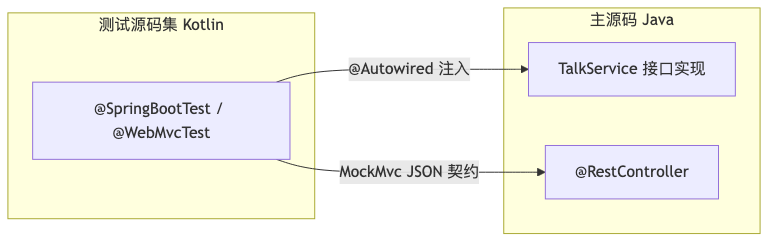
(1) Rationale: In existing Java monoliths or modular projects, restricting Kotlin to test source sets lets you validate the build chain, dependencies, and IDE experience without changing the public API; controllers and service implementations can remain Java while Kotlin tests consume contracts through the Spring container or MockMvc.
(2) Implementation levers: Gradle/Maven configure the Kotlin plugin and kotlin-test / JUnit 5 for tests; Spring Boot summarizes interoperability with Java libraries in its Kotlin support guide and points to Spring Framework’s Kotlin language support. Types such as @RestController and TalkService in main code can be @Autowired or constructor-injected from Kotlin tests directly.
(3) How to use: Below, a Kotlin test depends on a Java controller’s DTO; business details are omitted—only the interop axis is shown.
@SpringBootTest
class TalkHttpContractTest @Autowired constructor(
    private val talkService: TalkService // Java interface
) {
    @Test
    fun `delegates to Java service`() {
        val created = talkService.createTalk(CreateTalkRequest(/* … */))
        assertNotNull(created.id)
    }
}
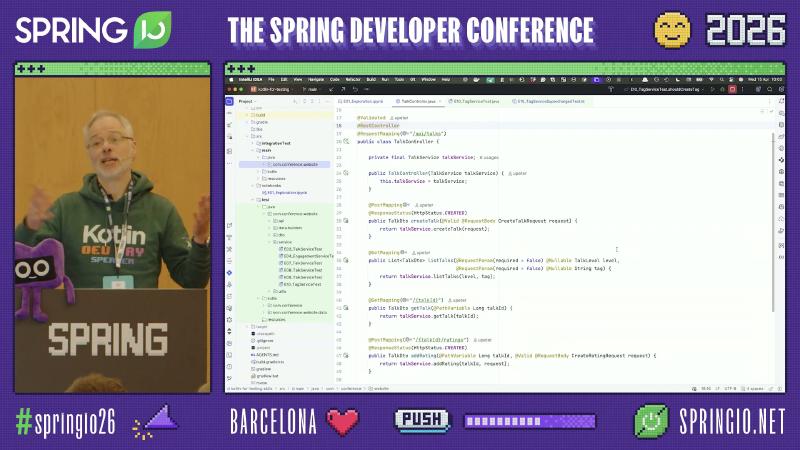
public TalkDto createTalk(@Valid @RequestBody CreateTalkRequest request).
2. Integration test skeleton: @SpringBootTest and readable assertion DSLs#
(1) Rationale: In similar scenarios, JUnit’s overload list for assertEquals can be noisy in the IDE, and failure messages may not foreground “collection semantics.” Libraries such as Kotest expose entries like shouldHaveSize and shouldBe, so assertion fragments read closer to natural language.
(2) Implementation levers: Test classes still use Spring’s @SpringBootTest, @Transactional (if rollback is needed); on the assertion side, bring in paths such as io.kotest.matchers.collections.shouldHaveSize. When you want several failures visible at once, consider Kotest’s assertSoftly (note the official list of assertion categories incompatible with assertSoftly); if you prefer compile-time enhancement of assert diagnostics, use Kotlin’s Power Assert compiler plugin (kotlin("plugin.power-assert") and related config per current Kotlin release notes). AssertJ soft assertions are a parallel option—see Soft assertions.
(3) How to use:
@Test
fun `tags size and name`() {
    val created = tagService.createTags(CreateTagsRequest(names = listOf("Kotlin")))
    created shouldHaveSize 1
    created.first().name shouldBe "kotlin"
}
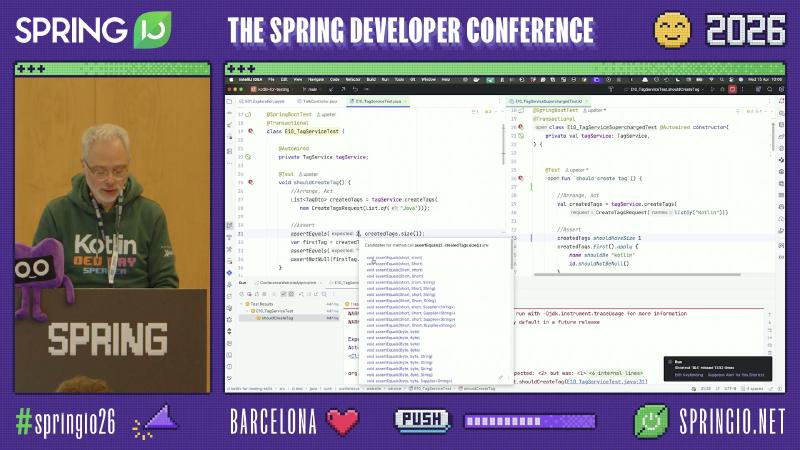
@SpringBootTest and a constructor-injected test class like class £10_TagServicesuperchargedTest @Autowired constructor(.
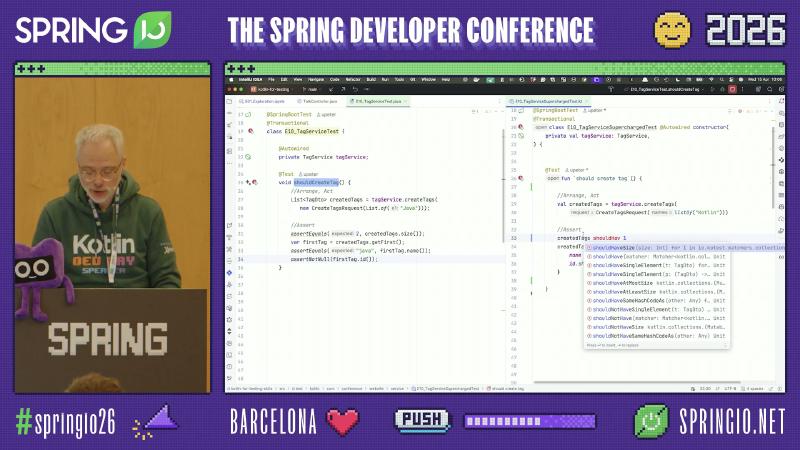
shouldHaveSize(size: Int) for I in io.kotest.matchers.coLtection.
3. Scoping functions to tighten local assertions: apply and single-element focus#
(1) Rationale: Multi-field assertions on a single DTO get noisy if you unpack layers of temporaries. apply opens a block on the receiver and returns it—good for “assert in place after taking the first collection element.”
(2) Implementation levers: Semantics in the Kotlin handbook: Scope functions — apply; often combined with Kotest matchers without adding another test framework.
(3) How to use:
createdTags.single().apply {
    name shouldBe "kotlin"
    id.shouldNotBeNull()
}
4. Test data: copy, Builder.from, and compile-time constraints#
(1) Rationale: Large Java builders often fail to distinguish required related entities at the type level—a Talk missing a Speaker may only surface at runtime. Kotlin’s data class copy, named parameters, and nullable types can pull some constraints forward; project-specific CreateSpeakerRequestBuilder.from(primary) supports “inherit fields from a baseline object then tweak locally”—concrete APIs depend on each repository (naming is not standardized in docs).
(2) Implementation levers: When Java calls Kotlin factories with default parameters, use @JvmOverloads to expose overload sets; non-null constraints: Null safety.
(3) How to use:
val primary = createSpeakerRequest(company = "Tst AG")
val co = primary.copy(name = "Sec Undo", email = "sec.undo@example.com")
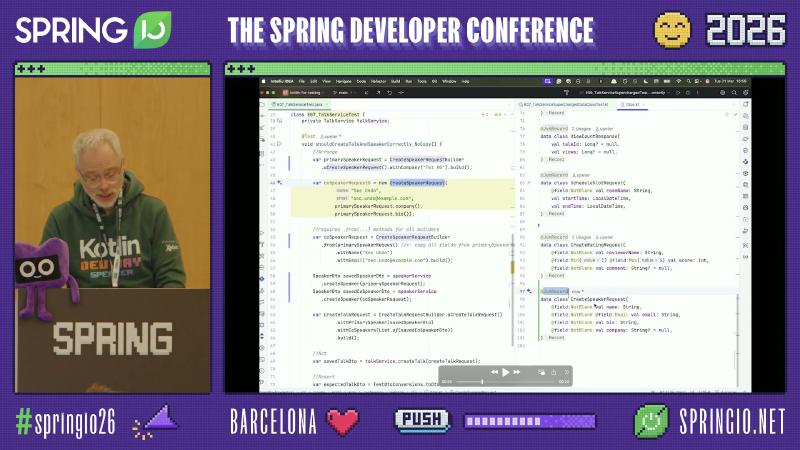
var prinarySpeakerRequest = CreateSpeakerRequest Builder and Builder calls like -abreateSpeakerRequest().withCompany("Tst AG") .buitd();.
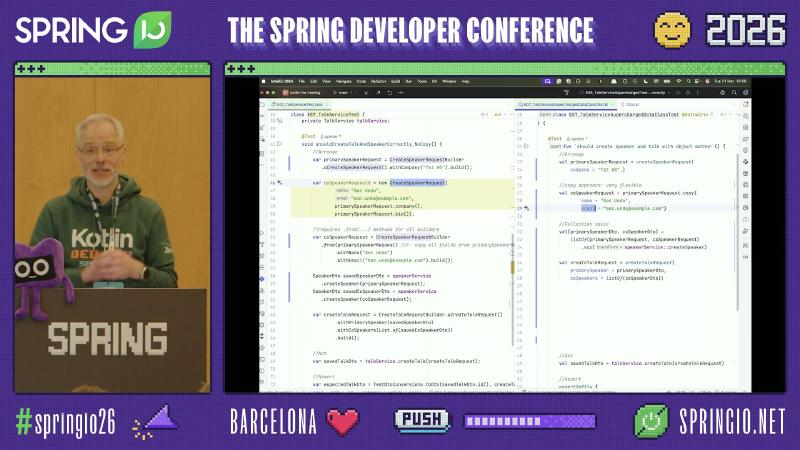
open fun "should create speaker and talk with object mother' () { and a side-by-side demo with primarySpeakerRequest.copy( and -from(primarySpeakerRequest) //<- copy all fields from prinarySpeake.
5. MockMvc: Kotlin extensions to fold repeated headers and JSON glue#
(1) Rationale: In controller tests, Authorization, X-Correlation-Id, Content-Type, and ObjectMapper serialization recur. Spring’s MockMvc and MockHttpServletRequestBuilder#header provide a single entry; Kotlin extensions and default parameters let you build an in-team “test DSL” without modifying framework types.
(2) Implementation levers: The mockMvc.perform(RequestBuilder) contract is in MockMvc Javadoc. The demo assumes X-Correlation-Id and Authorization as examples only—production should follow your org’s gateway and observability standards.
(3) How to use (client MockMvc + server reading demo headers):
fun MockHttpServletRequestBuilder.correlationIdHeader(id: String) =
    header("X-Correlation-Id", id)

fun MockHttpServletRequestBuilder.authorizationHeader(token: String) =
    header("Authorization", "Bearer $token")

fun <T> MockHttpServletRequestBuilder.jsonBody(mapper: ObjectMapper, body: T) =
    contentType(MediaType.APPLICATION_JSON).content(mapper.writeValueAsString(body))
@RestController
@RequestMapping("/api/tags")
class TagController {
    @PostMapping
    ResponseEntity<Void> create(@RequestHeader(name = "X-Correlation-Id", required = false) String corrId,
                                 @RequestBody CreateTagsRequest body) {
        // Demo: read correlation id; real systems may wire MDC / tracing context
        return ResponseEntity.status(HttpStatus.CREATED).build();
    }
}
@Test
fun `post tags with headers`() {
    mockMvc.perform(
        post("/api/tags")
            .correlationIdHeader("1284567890")
            .authorizationHeader("token")
            .jsonBody(objectMapper, CreateTagsRequest(names = listOf("java", "kotlin")))
    ).andExpect(status().isCreated)
}
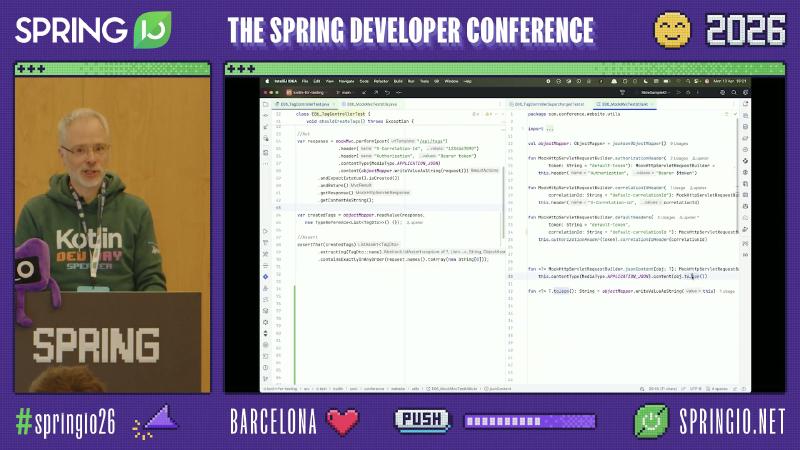
MockMvc calls show header( name: "X-Correlation-Id", values: "1284567890") and sheader( name: "Authorization, values: "Bearer token"); the right pane shows a default-token default-parameter extension wrapper on MockHttpServletRequestBuilder.
6. Java static helper explosion vs Kotlin default parameters#
(1) Rationale: Adding a Java overload for every header combination tends to produce families of static methods with similar parameter order and overlapping semantics; Kotlin default arguments and extension functions can fold cross-cutting concerns into one entry.
(2) Implementation levers: Same Spring MockHttpServletRequestBuilder on both sides—the only difference is call style. That “parameter positions inevitably clash” is an empirical claim; docs give no formal proof.
(3) How to use: Combine the previous section’s correlationIdHeader / authorizationHeader into a defaulted withStdHeaders(token = "…", correlationId = "…") to cover most cases without extra overloads for optional headers.
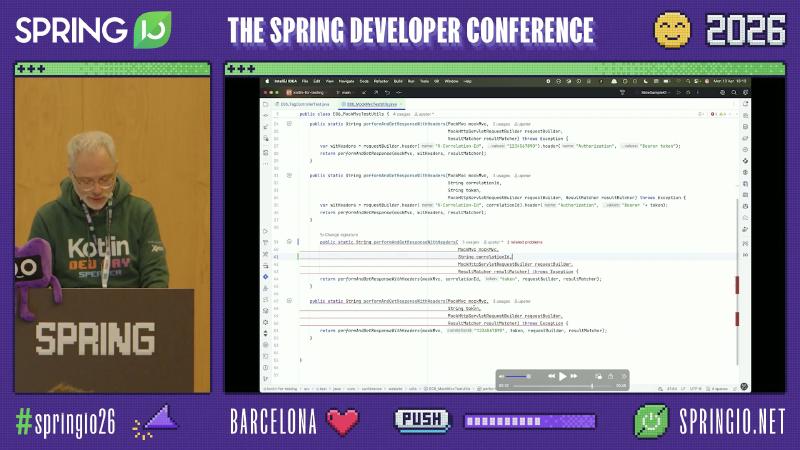
public class E06 MockHveTestUtiLs shows performindGetResponseliithHeaders and multiple performAnd…WithHeaders overload sketches differing only in parameter order.
7. reified and response body deserialization boilerplate#
(1) Rationale: After JVM erasure, the runtime Type for List<T> often needs an anonymous subclass to carry the type argument; Spring offers ParameterizedTypeReference, and on the Jackson side you commonly see TypeReference (package and construction per your jackson-databind version Javadoc). Kotlin inline + reified can wrap that in one-shot extensions.
(2) Implementation levers: MvcResult#getResponse returns MockHttpServletResponse; body text via getContentAsString.
(3) How to use (illustrative: Jackson TypeReference name as implemented):
inline fun <reified T> MvcResult.readBody(mapper: ObjectMapper): T =
    mapper.readValue(response.contentAsString, object : TypeReference<T>() {})

@Test
fun `parse tag list`() {
    val tags: List<TagDto> = mockMvc.perform(get("/api/tags"))
        .andExpect(status().isOk).andReturn()
        .readBody(objectMapper)
    tags shouldHaveSize 2
}
8. Type-safe DSLs for nested domain graphs#
(1) Rationale: Persistence fixtures spanning multiple entities and Talk / Speaker / Tag relations are hard to scan if you rely only on ad hoc builders and temps. Kotlin function literals with receiver plus @DslMarker can rule out illegal nesting so “declare entities inside a local scope” becomes a syntactic constraint.
(2) Implementation levers: Internal mutable builders + build() returning an immutable snapshot; expose an entry like testGraph { talks { talk { … } } }.
(3) How to use:
@Test
fun `nested talks dsl`() = testGraph {
    talks {
        talk {
            title = "Kotlin DSL Power"
            primarySpeaker { name = "Ada"; email = "ada@example.com" }
        }
    }
}.let { persistGraph(it) }
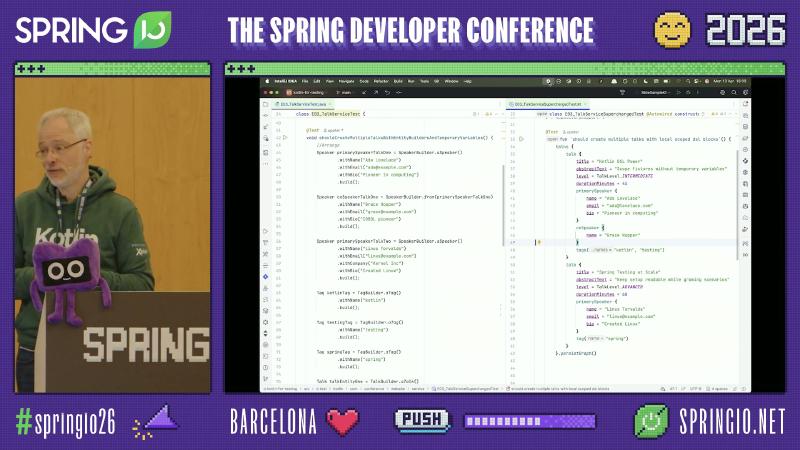
abstractIext = "Scope fixtures without temporary variables" and nested talks { talk { title = "KotLin OSL Pore" structure.
9. Project Reactor: StepVerifier and the complete signal#
(1) Rationale: When combining parallel calls with Mono.zip and Tuple2, deep assertion chains make failures hard to localize. StepVerifier requires you to drive verification explicitly; verifyComplete documents that it expects a completion signal as the terminal event—if the test never calls verify / verifyComplete (or similar), you do not have a full subscription verification (whether that surfaces as a “false green” still depends on exact code and the test runner; the risk is framed here per official semantics).
(2) Implementation levers: Reactor Test module; Mono.zip yields Mono<Tuple2<…>>.
(3) How to use:
@Test
void recordsParallel() {
    StepVerifier.create(service.recordBoth(1L, req1, req2))
        .assertNext(t -> assertThat(t.getT1().views()).isEqualTo(1))
        .verifyComplete();
}
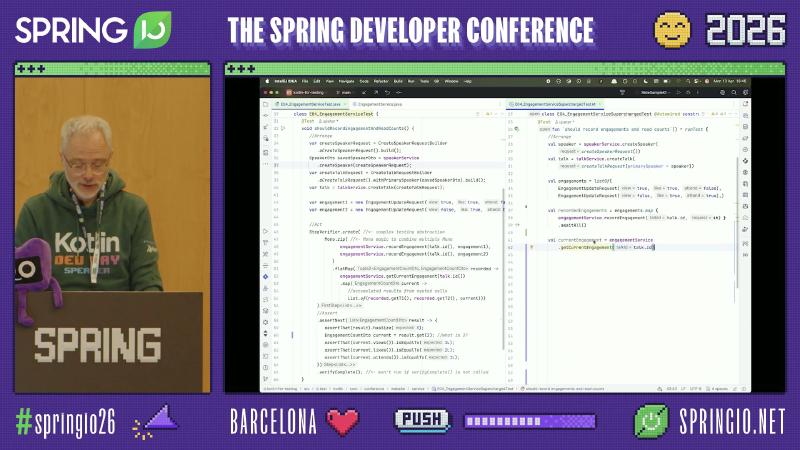
Stepverifien.create(, Mono.zip composition, and closing verifyconplete() (OCR typos do not change the APIs referenced).
10. Kotlin coroutine tests and Reactor suspend interop#
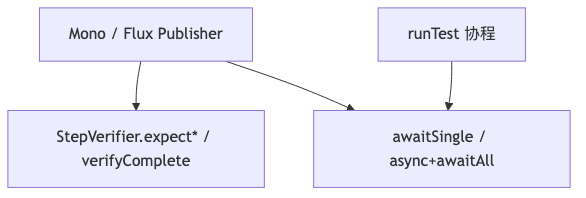
(1) Rationale: Treating Mono as a suspension boundary lets you write the main assertion path in sequential style. runTest drives coroutine test scheduling; Mono.awaitSingle waits for a single value on non-blocking threads.
(2) Implementation levers: awaitAll for collections of Deferred; if the business API returns a list of Monos, use async { mono.awaitSingle() } then awaitAll, or Reactor operators (e.g. merge Flux and assert once)—calling List<Mono<T>>.awaitAll() as if it were kotlinx’s Deferred extension will not match signatures; verify against return types before shipping.
(3) How to use:
@Test
fun `record engagements sequentially suspended`() = runTest {
    val talk = talkService.createTalk(createTalkRequest(speaker))
    val recorded = coroutineScope {
        engagements.map { req ->
            async { engagementService.recordEngagement(talk.id, req).awaitSingle() }
        }.awaitAll()
    }
    val current = engagementService.getCurrentEngagement(talk.id).awaitSingle()
    recorded shouldHaveSize 2
    current.views shouldBe 3
}
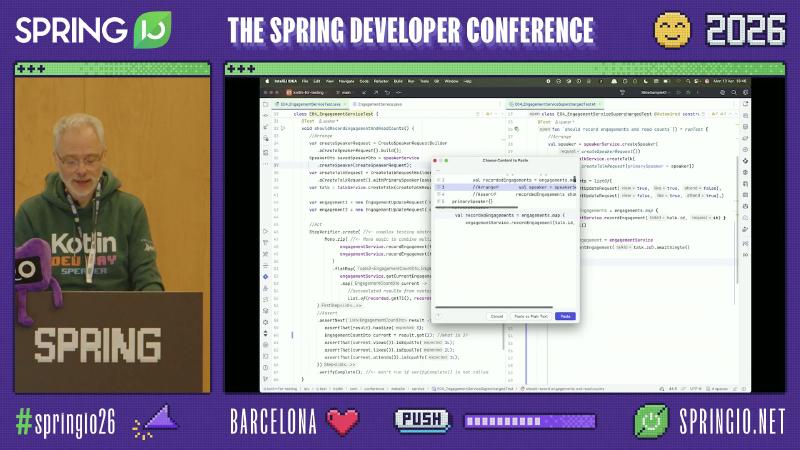
StepVerifier.create path vs Kotlin open fun "should record engagements and read counts" () = and val recordedengagenents = engagements.nap.
11. Kotlin Notebook and runtime probes (capability limits)#
(1) Rationale: Interactive notebooks suit short-path HTTP/JSON checks; IntelliJ Kotlin Notebook describes the cell execution model. Kotlin Notebook overview mentions calling APIs and handling JSON. Whether a cell can hold ApplicationContext beans from a running Spring app depends on kernel and project integration—the official Kotlin Notebook overview does not promise automatic injection of a remote Spring context; if you need that, consult your Jupyter / Kotlin Jupyter plugin and sample project configs.
(2) Implementation levers: On HTTP, Spring 6’s synchronous RestClient (RestClient.create(baseUrl), retrieve(), etc.).
(3) How to use (client probe sketch only):
val client = RestClient.create("http://localhost:8080")
val tags = client.get().uri("/api/tags").retrieve().body<List<TagDto>>()
tags.size
References and further reading#
- Spring Boot — Kotlin support and interoperability entry point
- Spring Framework — Kotlin language support
- Spring Framework — MockMvc testing guide
MockHttpServletRequestBuilderJavaDoc (includesheader)- Spring Framework —
RestClientreference section - Kotest — Core matchers (
shouldHaveSize, etc.) - Kotest — Soft Assertions (
assertSoftly) - AssertJ — Soft assertions
- Kotlin — Power-assert compiler plugin
- Kotlin — Scope functions (
apply) - Kotlin — Data classes —
copy() - Kotlin —
@JvmOverloadsand Java interop - Kotlin — Inline functions — Reified type parameters
ParameterizedTypeReferenceJavaDoc- Kotlin — Type-safe builders and
@DslMarker - Project Reactor —
MonoAPI (includeszip) - Reactor Test —
StepVerifiersource (verifyCompletecomments) - Kotlin —
runTestAPI Mono.awaitSingle(kotlinx-coroutines-reactor)awaitAll(collection ofDeferred)- Kotlin — Kotlin Notebook overview
- IntelliJ IDEA — Kotlin Notebook