

Spring Boot 4 空安全:JSpecify 如何把 NPE 前移到编译期#
Java 的 null 引用仍是生产环境中最常见的运行时故障源之一。Tony Hoare 曾将其称为「十亿美元错误」;Spring 团队的目标并非让 NullPointerException 从 JVM 中消失,而是在应用交付生产之前,通过静态分析与显式契约把大部分空引用问题拦截在编译期或构建期。
Spring Boot 4 与 Spring Framework 7 的选择,不是再发明一套厂商私有注解,而是全面拥抱 JSpecify——由 Google、JetBrains、Broadcom(Spring)等共同推进的跨工具空安全语义标准。对应用开发者而言,这意味着三层收益:其一,升级依赖后 IDE 与 Kotlin 编译器能读懂 Spring API 的 nullness,几乎零配置;其二,业务代码可按包渐进引入 @NullMarked,把 unspecified 区域逐步收窄;其三,NullAway 配合 Error Prone 能在 CI 里把契约违规升格为构建失败,与 Spring 源码库自身的门禁策略对齐。
本文按「为什么 → 机制/约束 → 怎么做 → 常见误区」梳理各层能力;凡未在官方规范或 Javadoc 中逐条核对的内容,会明确标注边界。
为什么需要跨工具的空安全标准#
为什么:NullPointerException 往往在集成测试覆盖不到的边界条件下暴露。注解若只被单一 IDE 识别,库作者无法保证「写一次、处处可分析」;历史上 JSR-305 在 Maven Central 存在多个互不兼容变体,进一步放大了混乱。
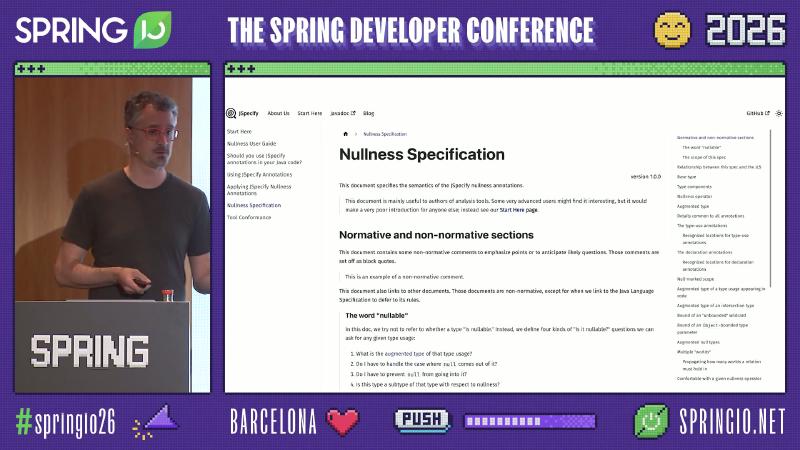
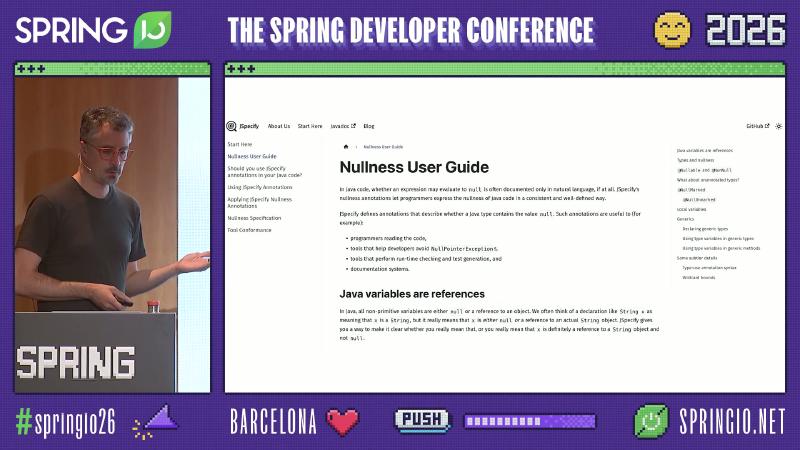
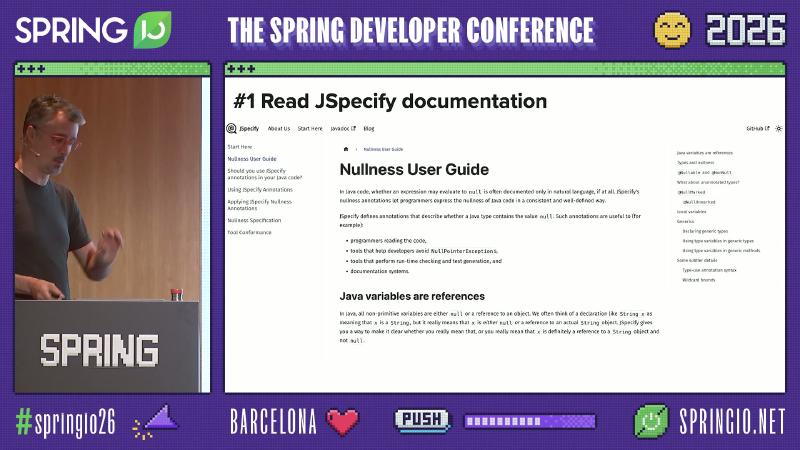
机制/约束:JSpecify 1.0.0 发布 Nullness Specification 与 Nullness User Guide,定义 augmented type、null-marked scope 等概念;Tool Conformance 文档说明工具应如何一致解释注解,但不强制工具在特定场景发出特定报错——语义统一与诊断严格度可以分离。
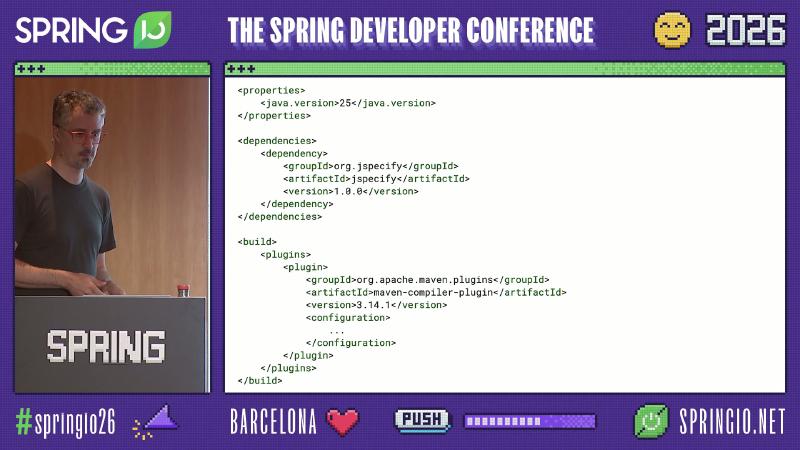
核心注解包括 @NullMarked、@Nullable、@NonNull。Maven 坐标:
<dependency>
  <groupId>org.jspecify</groupId>
  <artifactId>jspecify</artifactId>
  <version>1.0.0</version>
</dependency>
怎么做:阅读 User Guide 即可上手;Specification 1.0.0 面向工具实现者,普通应用开发者通常不必通读全文。
常见误区:把 JSpecify 当成「又一个 @Nullable」——它的价值在于作用域(包级默认 non-null)与泛型 parametric nullness 的完整语义,而非单个注解。另一个误区是认为规范会替你在运行时抛错——JSpecify 本身只是静态语义;真正在 CI 里 enforce 的是 NullAway 等工具,以及(远期)Valhalla 的 null-restricted types。
Spring Framework 7 弃用 org.springframework.lang#
为什么:Spring 5 时代引入的 org.springframework.lang 注解(@NonNull、@NonNullApi 等)无法与 Kotlin 2.1+、NullAway、JSpecify 工具链对齐;Spring Framework 7.0 Release Notes 明确将这些注解 deprecated in favor of JSpecify。
机制/约束:NonNull 自 7.0 起 @Deprecated(since="7.0"),迁移目标为 org.jspecify.annotations.NonNull。JSpecify 注解属于 TYPE_USE,字段与返回值上的位置可能与旧注解不同,需对照 迁移指南。
怎么做:
// 迁移前(已弃用)
import org.springframework.lang.NonNull;
void save(@NonNull String id) { }

// 迁移后
import org.jspecify.annotations.NonNull;
void save(@NonNull String id) { }
机械迁移可借助 OpenRewrite 或 Tanzu Application Advisor(演讲者推荐方向;具体 recipe 名称本次未在公开文档中核对)。
常见误区:手动全局替换 import 却忽略 type-use 位置差异,导致注解落在 declaration 而非 use-site,静态分析器读不到。
包级 @NullMarked 与 Spring 生态默认 non-null#
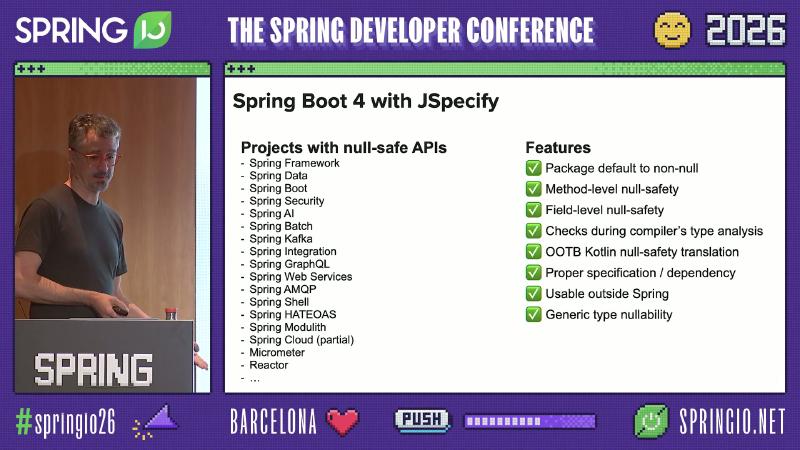
为什么:传统 Java API 默认可空,调用方只能靠 Javadoc 或读源码猜测。Spring 团队希望在 Framework、Boot、Security、Data、Reactor、Micrometer 等项目中统一策略:包默认 non-null,仅对确实可空的用法显式标 @Nullable。
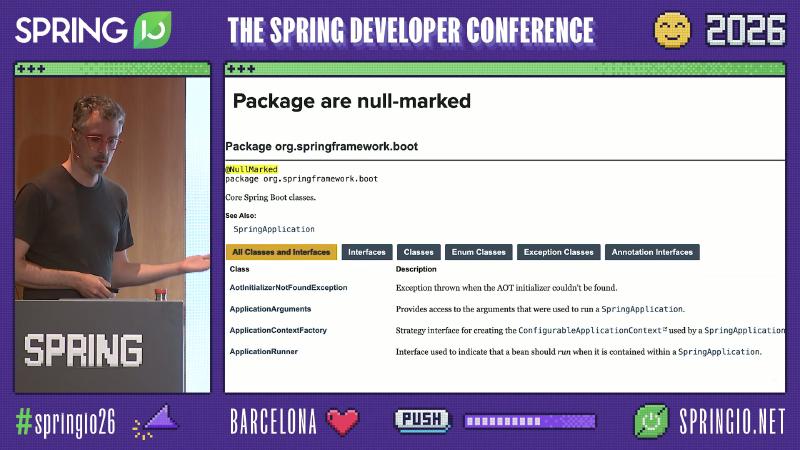
机制/约束:在 package-info.java 上声明 @NullMarked 后,该包内未标注的 type usage 视为 @NonNull。JSpecify User Guide 强调 Packages are not hierarchical——对 com.foo 标注不会自动覆盖 com.foo.bar,子包须各自维护 package-info.java。Spring 各项目在 CI 中集成 NullAway 防止注解与实现漂移(各仓库具体配置未逐仓库核验)。
「几乎每个 package 带 @NullMarked、仅约 5% 类型显式 @Nullable」来自 Spring 官方博客 与演讲口径,未找到正式统计脚本,作工程经验参考。
怎么做:
// src/main/java/com/example/app/package-info.java
@NullMarked
package com.example.app;

import org.jspecify.annotations.NullMarked;
常见误区:以为消费 Boot 4 后业务代码自动空安全——Spring 库的标注只覆盖库 API;应用自身包仍需自行引入 @NullMarked(见后文)。另外,Spring Cloud 等部分项目的标注覆盖仍不完整(partial,见生态清单幻灯片),跨模块调用时需单独确认目标模块是否已 @NullMarked。
Kotlin 2.1+ 与 JSpecify 的自动映射#
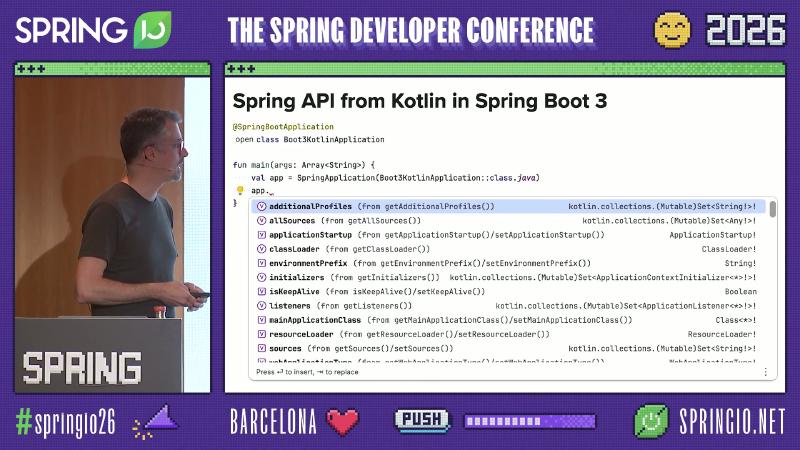
为什么:Boot 3 时代 Kotlin 调用 Spring Java API 时,未标注类型退化为 platform type(如 String!、Set<String!>!),编译器不阻止向 non-null 参数传 null,运行时仍有 NPE 风险。
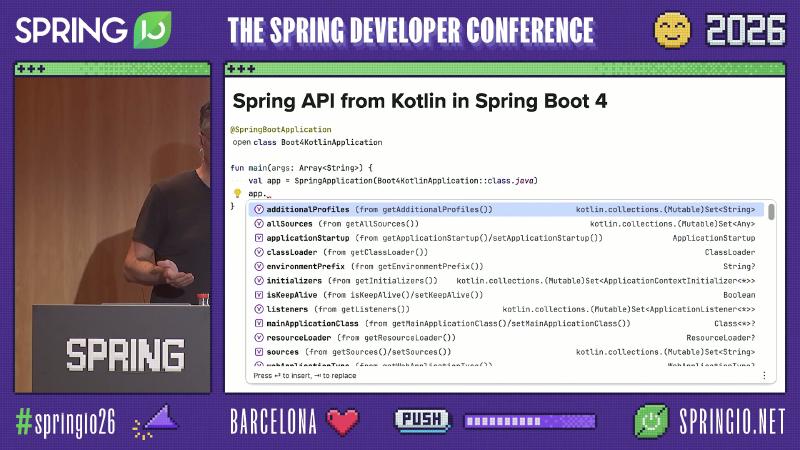
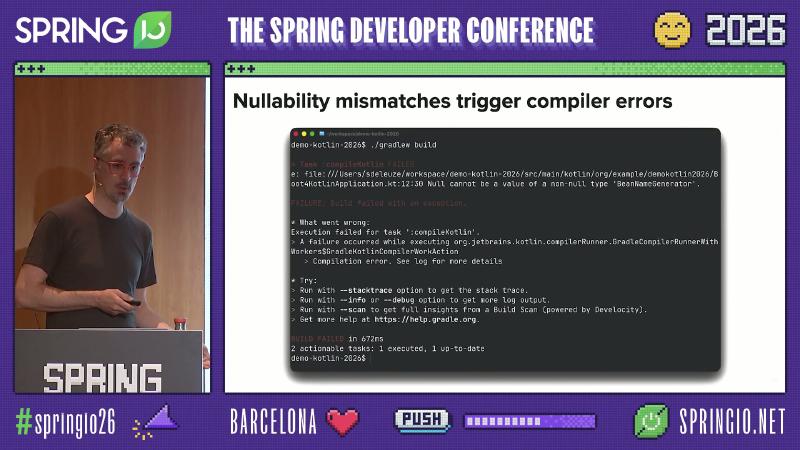
机制/约束:Spring Framework Reference 确认 JSpecify 注解自动翻译为 Kotlin 空安全。Kotlin 2.1.0 起对 JSpecify nullness mismatch 默认 strict(编译错误);JSpecify 是唯一默认 strict report level 的 Java 注解风格(Java interop 文档)。@Nullable → T?,其余在 @NullMarked 包内 → non-null T。
怎么做:
@SpringBootApplication
open class Boot4KotlinApplication

fun main(args: Array<String>) {
    val app = SpringApplication(Boot4KotlinApplication::class.java)
    val profiles: Set<String> = app.additionalProfiles   // 元素 non-null
    app.setBeanNameGenerator(null)  // 编译错误:参数为 non-null
}
Boot 3 同场景 IDE 仍显示 Set<String!>!;Boot 4 映射为 Set<String>:
常见误区:项目曾用 -Xnullability-annotations=@org.jspecify.annotations:warning 压制告警,升级 Kotlin 2.1 后默认值变为 strict,需在 Compatibility Guide 中确认行为变化。
IDE 静态分析:零迁移成本的即时收益#
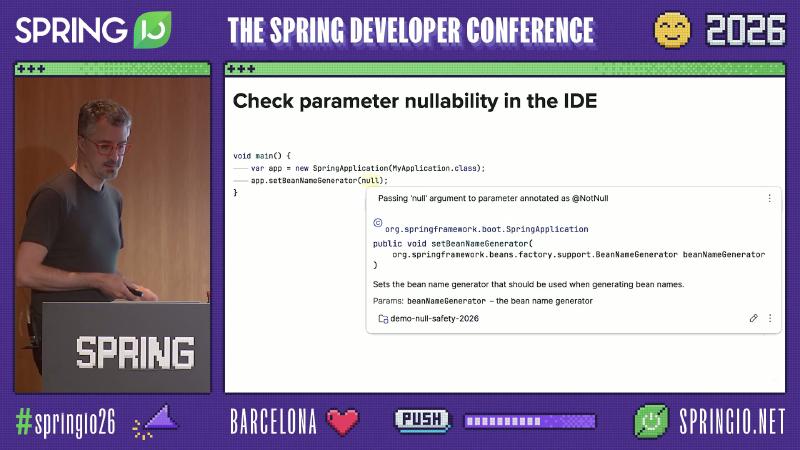
为什么:把 NPE 从生产前移到编辑期,成本最低的路径是只升级 Spring 依赖——支持 JSpecify 的 IDE 即可对 Spring API 给出 nullness 警告。
机制/约束:IntelliJ IDEA 默认 nullability 列表已含 org.jspecify.annotations.Nullable / NonNull。Spring 文档 亦推荐 IntelliJ 与 Eclipse(后者需手动配置)。VS Code Java 插件对 JSpecify 的原生支持未找到一手公开说明,此处标为演讲者观点。
关于 Optional:JDK Optional 的 @apiNote 明确其主要面向方法返回值;不宜作为通用 null 载体——这与 Spring 侧 API 设计取向一致。
怎么做:升级 Boot 4 后,对可空返回值解引用、向 non-null 参数传 null 等,IDE inspection「Nullability and data flow problems」会直接提示。
常见误区:IDE 无警告 ≠ 运行时安全——未标注的业务代码仍在 unspecified 状态;IDE 检查是辅助,不能替代构建期门禁。Spring AI 2.0 等子项目曾用 option 类型重构 API,把「值可能不存在」从隐式 null 改为显式建模(演讲者案例,未独立对照 Spring AI 2.0 源码变更)——这类设计层面的收益与注解检查互补,但超出本文静态分析范畴。
业务代码的渐进标注:unspecified 与 null-marked 双模型#
为什么:Spring 库再完善,应用业务代码仍是 NPE 主要来源。大型单体不可能 overnight 全库标注,需要可渐进扩展的作用域。
机制/约束:JSpecify User Guide 定义三态模型:
| 状态 | 含义 |
|---|---|
| unspecified | 未标注,工具「不知道能否为 null」,Kotlin 侧类似 platform type |
@NullMarked 内未标注 usage | 视为 @NonNull |
显式 @Nullable | 可空 |
库应将 org.jspecify:jspecify 作为传递依赖暴露(非 compile-only),以便下游工具读取 nullness(演讲者 Q&A 观点,与 Spring 指南方向一致)。
怎么做:
// com/example/orders/package-info.java
@NullMarked
package com.example.orders;

import org.jspecify.annotations.NullMarked;

public class OrderService {
    public @Nullable Order findById(String id) { return null; }
    public void save(Order order) { }  // order: non-null
}
常见误区:在父包加了 @NullMarked 就以为子包继承——不会;每个子包各自需要 package-info.java。
进阶表达:@Contract、泛型与数组 type-use#
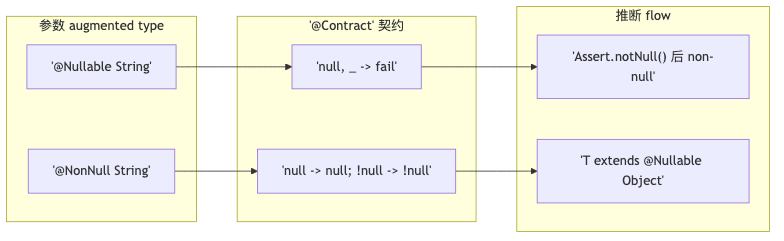
为什么:仅靠 @Nullable / @NonNull 无法描述「Assert.notNull 之后变量必 non-null」或「返回值 nullness 依赖参数 nullness」等控制流事实,NullAway 会产生大量误报。
机制/约束:
- Spring 保留
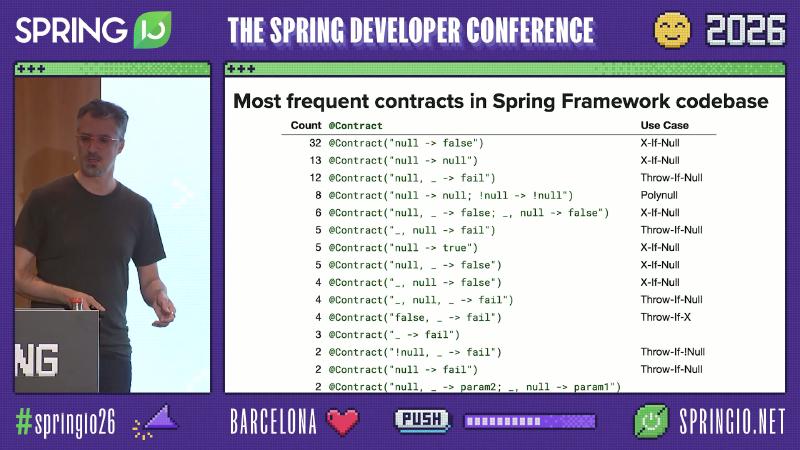
org.springframework.lang.Contract(未随空安全注解弃用),语义 inspired by JetBrains@Contract;Assert.notNull标注@Contract("null, _ -> fail")(源码可核对)。 - NullAway 需配置
NullAway:CustomContractAnnotations=org.springframework.lang.Contract方能识别 Spring 契约(Wiki)。 - 泛型边界:
TransactionCallback<T extends @Nullable Object>与@Nullable返回值组合决定 parametric nullness(spring-tx 源码)。 - 数组与嵌套类型须遵循 JLS type-use 位置:
@Nullable Object[](元素可空)vsObject @Nullable[](数组引用可空)vs@Nullable Object @Nullable[](两者皆可空)。
@Contract 纳入 JSpecify 标准化仍在工作组讨论中(演讲者观点;JSpecify 1.0 注解集不含 @Contract)。JSpecify 规范使用 parametric nullness 术语,而非口语「polynull」。
怎么做:
import org.springframework.util.Assert;

public void process(String foo) {
    Assert.notNull(foo, "foo required");
    foo.length(); // NullAway: foo known non-null after Assert
}
常见误区:把 Cache.@Nullable ValueWrapper 与 @Nullable Cache.ValueWrapper 混用——编译器解析的 augmented type 不同。
NullAway + Error Prone:构建期强制校验#
为什么:IDE 检查依赖开发者本地环境,无法保证团队与 Kotlin 消费方长期一致;Spring 各项目已在 CI 中用 NullAway 将 nullness 违规升为 error。
机制/约束:
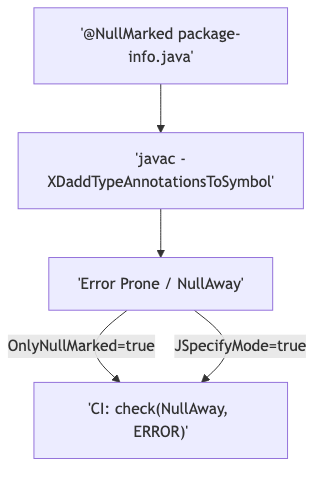
- NullAway 作为 Error Prone 插件运行;要求 JDK 17+ 与 Error Prone 2.36.0+。
NullAway:OnlyNullMarked=true:仅检查@NullMarked作用域,支持渐进采纳(Wiki)。NullAway:JSpecifyMode=true:启用更完整的 JSpecify 语义(泛型、数组等);仍在演进,可能误报(JSpecify Support Wiki)。注意官方选项名为JSpecifyMode,非部分演讲材料中的AcknowledgeJSpecifyMode。- Type annotation 字节码:NullAway 0.12.11+ 需要 JDK 22+ 的
javac,或在 OpenJDK 17.0.19+ / 21.0.8+ 上加-XDaddTypeAnnotationsToSymbol=true(Oracle JDK 17/21 不支持该 flag)。
怎么做(Gradle 要点,版本号以 NullAway README 为准):
tasks.withType<JavaCompile>().configureEach {
    options.errorprone {
        disableAllWarnings.set(true)
        check("NullAway", CheckSeverity.ERROR)
        option("NullAway:JSpecifyMode", "true")
        option("NullAway:OnlyNullMarked", "true")
        option("NullAway:CustomContractAnnotations", "org.springframework.lang.Contract")
    }
}
Spring 文档 建议分阶段启用:先 OnlyNullMarked + CustomContractAnnotations,再开 JSpecifyMode。可复现样例见演讲者仓库 jspecify-nullaway-demo。
Maven 侧需在 maven-compiler-plugin 中配置 fork=true、annotationProcessorPaths(error_prone_core + nullaway)以及 compilerArgs 传递 NullAway 选项与 -XDaddTypeAnnotationsToSymbol(OpenJDK 17.0.19+ / 21.0.8+)。demo 仓库的 maven 分支提供完整 pom.xml 参考。目标字节码级别可用 --release 17 与较新 javac 分离——编译器版本与运行时 JDK 不必相同。
可选地,Error Prone 的 RequireExplicitNullMarking checker 要求类或包显式声明 @NullMarked 或 @NullUnmarked,比仅开 NullAway 更严格;是否启用取决于团队对「未决策区域」的容忍度。
常见误区:用较旧 javac 编译却开启 JSpecifyMode——type annotation 无法写入 class 文件,NullAway 读不到 use-site 标注。另一误区是把演讲/demo 中激进的「一步到位 JSpecifyMode」当作 Spring 官方唯一推荐——文档实际建议分阶段启用。
Agent 辅助标注:经验编码为可迭代规则#
为什么:大规模手写 JSpecify 标注成本高,规则细碎(泛型、数组、Contract、推断 @Nullable),通用 LLM 提示 "add JSpecify to my project" 容易失败。
机制/约束:Spring Security 团队实践(演讲者分享,非官方规范):预先创建 Agent Skills——jspecify-user-guide(来自 User Guide URL)、jspecify-spring-null-safety、jspecify-spring-framework-patterns(分析 spring-core 源码模式)、nullaway-configure(来自 demo 仓库)——再执行「标注 → 构建 → 读 NullAway 错误 → 修复 → 沉淀规则到 jspecify-agentic-loop-analysis」循环。模型效果因负载与版本而异,非确定性。
怎么做:将 JSpecify User Guide 与 Spring null-safety 文档、NullAway 配置各自固化为 skill,按包小步推进;每轮构建失败日志是下一轮修复的输入。工作流骨架大致为:(1)从 User Guide URL 创建 jspecify-user-guide skill;(2)从 Spring null-safety 文档创建 jspecify-spring-null-safety;(3)分析 spring-core GitHub 创建 jspecify-spring-framework-patterns;(4)从 demo 仓库创建 nullaway-configure;(5)配置 NullAway;(6)按包标注并循环构建直至 clean;(7)把新规则追加到 jspecify-agentic-loop-analysis。演讲者称 Claude Sonnet/Opus 效果较好,Gemini 尝试失败——模型选型为个人经验,非官方结论。
常见误区:把 agent 输出当作可 merge 的终态——仍需人工 review 与 CI 门禁;skill 名称与提示词无 Spring/JSpecify 官方固定包。也不要跳过 NullAway 配置直接让 agent 批量加注解——没有构建反馈环,标注质量无法验证。
运行时反射:org.springframework.core.Nullness#
为什么:框架特性(如 @RequestParam 是否 mandatory)需要在运行时查询参数 nullness,且须同时理解 JSpecify、Kotlin 反射与各包 @Nullable。
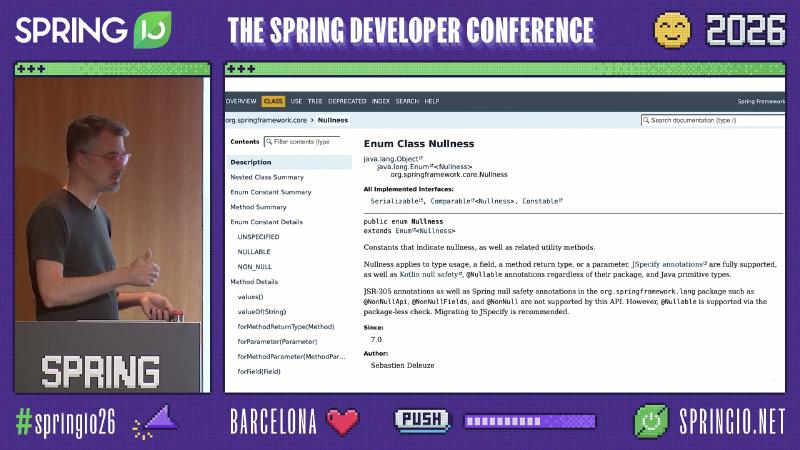
机制/约束:Nullness 枚举(since 7.0)取值 UNSPECIFIED / NULLABLE / NON_NULL;工厂方法 forMethodReturnType、forParameter、forMethodParameter、forField 等。Fully supported:JSpecify、Kotlin null safety、任意包的 @Nullable(无包名检查)。Not supported:JSR-305;org.springframework.lang 的 @NonNullApi / @NonNullFields / @NonNull(@Nullable 仍可通过无包名检查支持)。
怎么做:
import org.springframework.core.Nullness;
import java.lang.reflect.Method;

Method m = MyController.class.getMethod("handle", String.class);
Nullness p0 = Nullness.forParameter(m.getParameters()[0]);
// UNSPECIFIED 时 @RequestParam 默认 mandatory(演讲举例;具体还取决于 required 等属性)
常见误区:以为 Nullness API 会解析 @Contract——它只处理 nullness,不解析控制流契约。
Project Valhalla 与 null-restricted types 前瞻#
为什么:纯注解方案表达语义但不改变内存布局;Project Valhalla 路线图中的 null-restricted types 拟将 null 检查纳入编译期与运行时,并支撑 value class 对齐优化。
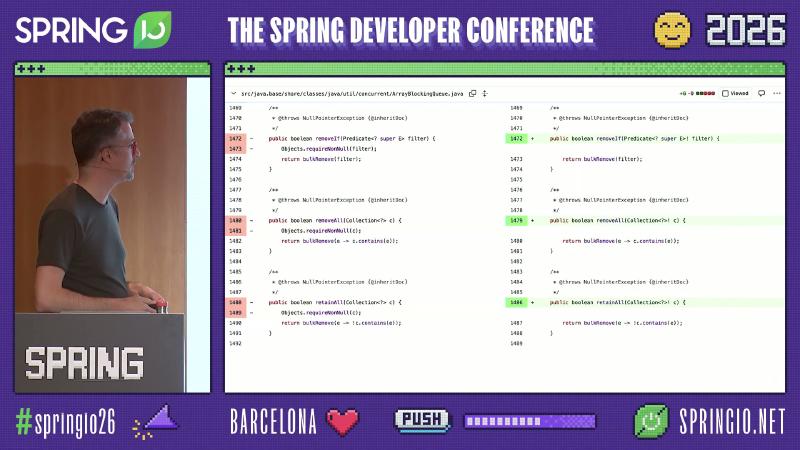
机制/约束:JEP 8316779(Draft)定义 preview 语法:类型名后缀 ! 表示 non-null restricted,如 Predicate<? super E>!。启用 preview 需 --enable-preview。JSpecify 仍是当下 pragmatic 方案;从 JSpecify 注解处理器迁移到字节码级 null 特性、lazy constants 等属于路线图方向,时间线未验证。
怎么做(preview 语法示意,非 GA 特性):
// Preview: non-null parameter type
public boolean removeIf(Predicate<? super E>! filter) {
    return bulkRemove(filter);
}
常见误区:在 production 代码中依赖 preview 语法——JEP 仍为 Draft,语法与 JDK 基线可能变动。也不要因为 Valhalla 远期规划而推迟 JSpecify——Spring 7 文档与 OpenJDK 路线图均把 JSpecify 视为当前 pragmatic 层,Valhalla 的泛型 nullness 能力预计仍不如 JSpecify 完整(演讲者观点)。
落地路径速览#
若你正在规划 Boot 3 → Boot 4 升级,可按依赖关系分层推进:
- 升级即收益:Bump Spring Boot 4 / Framework 7,在 IntelliJ 中打开现有代码,观察 Spring API 的 nullness 提示;Kotlin 项目确认编译器 ≥ 2.1。
- 清理自有 Spring 注解:将
org.springframework.lang.*迁移至 JSpecify(OpenRewrite / Advisor,或机械替换 + 人工核对 type-use 位置)。 - 选定首个
@NullMarked包:从核心业务模块或 NPE 高发模块开始,添加package-info.java,根据 NullAway/IDE 报错补@Nullable。 - 接入 CI 门禁:Error Prone + NullAway,
OnlyNullMarked=true起步,再按需开JSpecifyMode与CustomContractAnnotations。 - 运行时需求:框架扩展或自定义参数解析可查询
Nullness.forParameter,但应优先完成 JSpecify 迁移——旧 Spring@NonNullApi不被该 API 支持。
空安全不是一次性项目,而是把「值是否存在」从隐式约定变成可机器检查的契约;Spring Boot 4 把生态库的契约准备好了,应用侧的工作才刚开始。
参考与延伸阅读#
- JSpecify 官网 — Standard Annotations for Java Static Analysis
- Nullness Specification 1.0.0 — augmented type 与 null-marked scope 规范
- Nullness User Guide — @NullMarked 与 unspecified nullness 说明
- Spring Framework 7 — Null-safety 参考文档与迁移指南
- Spring Framework 7.0 Release Notes — org.springframework.lang 弃用说明
- Spring Boot 4 空安全官方博客 — 生态标注策略与 Kotlin 互操作
- NullAway GitHub — Error Prone 插件安装与 Gradle/Maven 配置
- NullAway Wiki — JSpecifyMode、OnlyNullMarked 与 JDK 版本要求
- Kotlin 文档 — JSpecify 注解到 Kotlin 空安全的映射规则
- Kotlin 2.1 Compatibility Guide — JSpecify mismatch 默认升为编译错误
- org.springframework.core.Nullness Javadoc — 运行时反射 API 与支持范围
- Project Valhalla — null-restricted types 与 value class 路线图
- JEP 8316779 — Null-Restricted Value Class Types (Preview) 草案
- jspecify-nullaway-demo — Gradle/Maven NullAway 可复现配置样例